
Starting June 1st, 2023 Our warehouse fee will be $0.65/cubic foot per month
In effort to lower the warehouse storage fee during inflation, we have went narrow aisle racking.This construction took us four months but the project is finally completed. With narrow aisle racking, we are able to drop storage by 24%.We as partners will go through this inflation together.
04/14/2026
In 2026, navigating 3PL pricing requires more than just comparing storage and pick and pack fees; it demands a strategic understanding of how 5.9% carrier hikes and hidden aged inventory surcharges can quietly erode your profit margins if left unchecked. While many e-commerce brands believe they have a handle on their fulfillment costs, the reality of the current logistics landscape is far more volatile, with opaque fee structures often masking the true cost of doing business. Are you certain your current provider isn't overcharging you for inefficient SKU management, or is your bottom line about to be blindsided by the next wave of ancillary operational spikes?
3PL pricing in 2026 is defined by a shift toward data-driven transparency and behavior-based cost structures. As global supply chains face a cocktail of fluctuating fuel costs, labor shortages, and rapid automation, the flat-rate pricing models of the past are being replaced by dynamic fees that reward efficiency and penalize high-maintenance inventory. For ecommerce brands and global retailers, understanding these shifts is no longer optional it is a requirement for maintaining healthy profit margins in a hyper-competitive market.
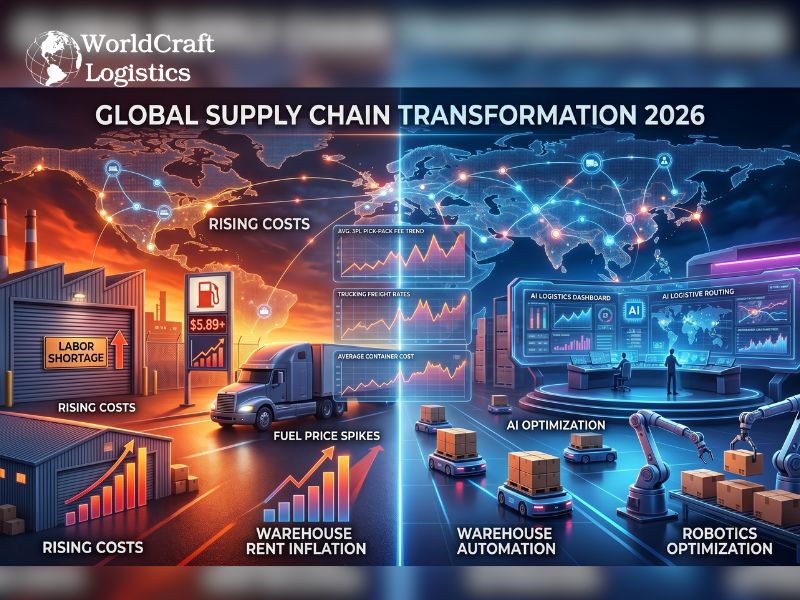
The logistics landscape has entered a period of sticky inflation. While the extreme spikes of the early 2020s have stabilized, the baseline costs for warehouse real estate and specialized labor remain historically high. In 2026, 3PL providers are passing through these operational overheads via higher base storage rates and increased surcharges for manual value-added services (VAS). Brands that fail to optimize their SKU counts or packaging dimensions are seeing their fulfillment costs eat up an additional 4% to 7% of their gross revenue compared to two years ago.
One of the most significant drivers of 3PL pricing change this year is the 2026 General Rate Increase (GRI). Major global carriers, including UPS and FedEx, have implemented a standard 5.9% rate hike, with even steeper increases for non-standard packages and residential deliveries. Because shipping often accounts for 60% to 70% of the total landed cost per order, 3PLs are renegotiating their volume-based discounts to help offset these spikes. At Worldcraft Logistics, we emphasize that a 3PL's value is increasingly measured by its ability to mitigate these carrier hikes through strategic zone skipping and optimized postal injections.
In an attempt to win market share, some newer fulfillment players are marketing zero-fee onboarding or low-cost pick and pack rates. However, these cheap 3PL providers often hide their true margins in opaque surcharges. These can include:
Dimensional (DIM) weight markups that exceed standard carrier rates.
Undisclosed Technology Fees for WMS access.
Hefty Account Management surcharges triggered by simple support tickets.
Inbound receiving penalties for non-compliant labeling.
The objective of this guide is to pull back the curtain on the 3PL pricing structure for 2026. We aim to provide a clear, benchmark-driven framework that allows supply chain managers and founders to accurately project their fulfillment cost per order. By the end of this article, you will be equipped to distinguish between a low-cost provider and a high-value partner, ensuring your logistics strategy supports scalable growth rather than draining your bottom line.
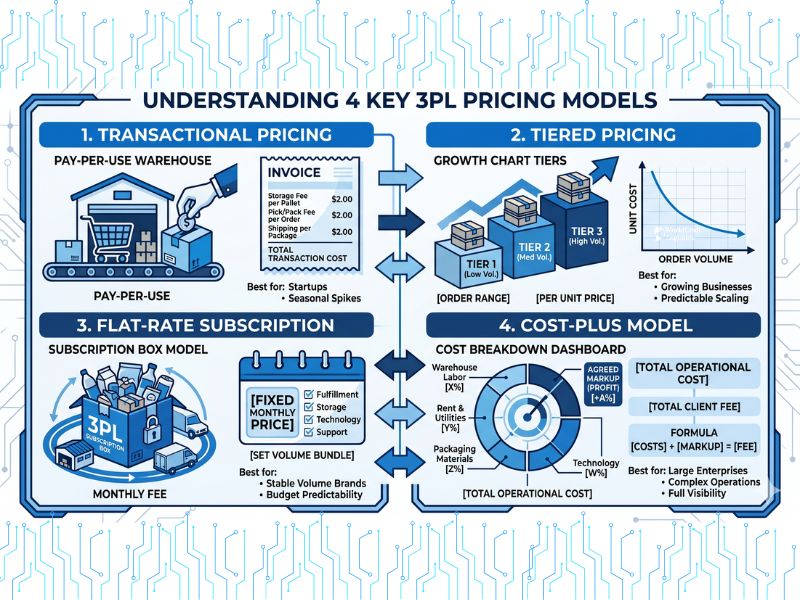
Selecting the right 3PL pricing model is a strategic decision that directly impacts your unit economics. In 2026, providers have moved away from one-size-fits-all contracts toward structures that align with a brand’s growth stage and SKU complexity. Understanding these four primary models allows logistics managers to forecast expenses with precision.
Best for: Startups, seasonal businesses, and low-volume ecommerce brands.
The Transactional model is the entry point for most businesses outsourcing fulfillment for the first time. Under this structure, you only pay for the services you use—per pallet stored, per order picked, and per item packed. There are typically no long-term commitments or high monthly minimums, making it ideal for testing new markets.
Pros: Low risk and highly scalable during slow months.
Cons: Higher unit costs compared to volume-based models. As you scale, the lack of bulk discounts can make this the most expensive option per order.
Best for: Rapidly growing ecommerce brands with predictable scaling.
Tiered pricing rewards volume. As your monthly order count hits specific benchmarks (e.g., 1,000 orders, 5,000 orders, 10,000+ orders), the pick and pack fees and third-party logistics pricing for storage usually decrease. This model is designed to grow with you, ensuring that as your revenue increases, your fulfillment cost as a percentage of sales remains stable or declines.
Pros: Incentivizes growth and provides a clear roadmap for cost reduction.
Cons: If your volume drops below a tier threshold, your costs per order can spike unexpectedly.
Best for: High-volume sellers with standardized packaging and low SKU complexity.
In 2026, the subscription-based fulfillment model has gained significant traction. Brands pay a fixed monthly fee that covers a predetermined number of orders, storage space, and sometimes even standard packaging materials. This provides maximum budget predictability for box-of-the-month clubs or brands with highly consistent sales cycles.
Pros: Simplifies accounting and eliminates invoice shock from variable fees.
Cons: You may end up pre-paying for services you don't use during a down month, and overage fees can be steep.
Best for: Enterprise logistics operations and complex global retail brands.
The Cost-Plus model is the most transparent approach to 3PL fulfillment pricing. The provider shares their actual operational costs (labor, rent, utilities) and adds a fixed management fee or percentage margin on top. This is common in dedicated or captive warehouse environments where the 3PL manages a facility exclusively for one client.
Pros: Total visibility into every penny spent; easy to audit and optimize.
Cons: Requires high volume to justify the overhead and usually involves long-term, complex contractual commitments.
In the current 2026 market, many leading 3PLs are adopting Hybrid Models. For example, a brand might pay a flat rate for storage to lock in warehouse space but use a transactional model for pick and pack to handle seasonal spikes. At Worldcraft Logistics, we often recommend hybrid structures to balance cost-efficiency with the flexibility needed to navigate global supply chain shifts.
Navigating the line items of a 2026 fulfillment invoice requires a granular understanding of how labor and real estate are priced. While many providers market a single fulfillment cost, the reality is a composite of several distinct operational phases.
To help you compare providers accurately, we have compiled the 2026 3PL Pricing Benchmarks in the table below. These figures reflect current global market rates for mid-to-high volume ecommerce fulfillment.
To accurately forecast your fulfillment cost per order, you must understand the specific variables within these four core service areas.
Onboarding & Setup Fees: This one-time investment ($250–$1,500) covers WMS integration with platforms like Shopify or Amazon. In 2026, this increasingly includes data sanitization to ensure SKU dimensions are perfectly synced, preventing downstream billing discrepancies.
Inbound Receiving Fees: Receiving is priced by labor intensity. Ready-to-stow pallets typically cost $5–$15 each. However, floor-loaded containers or mixed-SKU shipments often trigger hourly rates ($35–$55) due to the manual sorting and QC inspections required.
Warehouse Storage Costs: Storage pricing in 2026 reflects high demand for urban-adjacent real estate:
Pallet Storage: $18–$40/month. Best for bulk, uniform inventory.
Cubic Foot Storage: $0.45–$0.60/cu-ft. A cost-effective choice for small and light products, where you only pay for the utilized volume.
Pick and Pack Fees: This is the direct labor of fulfillment. In tier-1 facilities, robotic-assisted picking helps maintain these 2026 benchmarks:
Primary Pick: $2.00–$3.00 (includes the first item and standard shipping box).
Add-on Pick: $0.30–$0.75 (discounted rate for additional items in the same order).
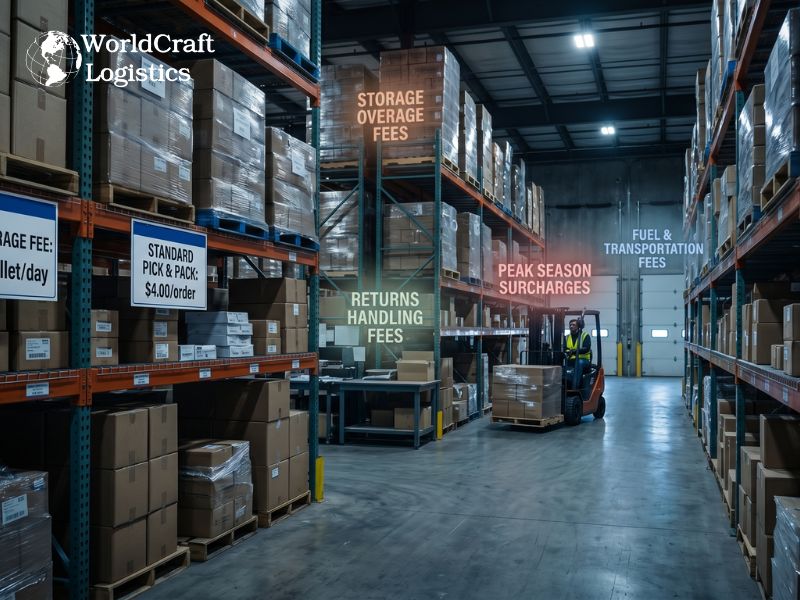
The true third-party logistics pricing is often found in the fine print. As 3PLs tighten margins in 2026, ancillary fees have become standard. To protect your profit, watch for these four common expenses.
Warehouse space is at a premium. Most 3PLs now penalize slow-moving SKUs that sit longer than 180 days.
Expect your warehouse storage cost to double or triple for stale inventory. Monitor your inventory turnover ratio monthly to avoid these 100% markups.
With 2026 return rates averaging 20-30%, processing returns is a major expense. It is often more expensive to receive an item than to ship it due to manual labor.
The cost is $3.50 – $6.00 per return. Detailed Quality Control (QC) inspections for damaged goods will always incur higher fees than simple back-to-shelf restocking.
Peak season now extends beyond Q4. 3PLs apply surcharges during high-volume events like Prime Day or major sales holidays.
Labor surcharge, a $0.50 – $1.50 flat fee per order to cover seasonal temporary staff. Temporary spikes from carriers (UPS/FedEx) can increase shipping rates by 10-15%.
Unless you have a flat-rate contract, packaging is rarely included in the base pick and pack fees.
Custom boxes often trigger special handling fees. Expect a $0.20 – $0.50 material fee per order for dunnage, tape, and mailers.
To truly understand your 3PL pricing, you cannot look at individual fees in isolation. Successful ecommerce brands in 2026 calculate their Total Landed Cost per Order. This metric accounts for every penny spent to get a product from the warehouse shelf to the customer’s doorstep.
Use the following formula to determine your actual unit economics. This calculation should be performed monthly to account for fluctuations in storage and shipping volume.
Total Monthly 3PL Fees: Includes storage, receiving, pick/pack, and account management fees.
Total Orders: The actual number of unique shipments sent out during that month.
Average Shipping Cost: The net carrier cost after 3PL volume discounts is applied.
Imagine a brand selling 2,000 orders per month with 100 pallets in storage.
>>> Result: $24,000 / 2,000 orders = $12.00 Total Fulfillment Cost per Order.
Relying on a simple spreadsheet is no longer enough. In 2026, we recommend using a 3PL pricing template excel or a dedicated 3PL pricing calculator that factors in DIM Weight (Dimensional Weight). Since carriers now charge based on the space a package occupies rather than just its actual weight, failing to account for box dimensions can lead to a 15-20% error in your cost projections.
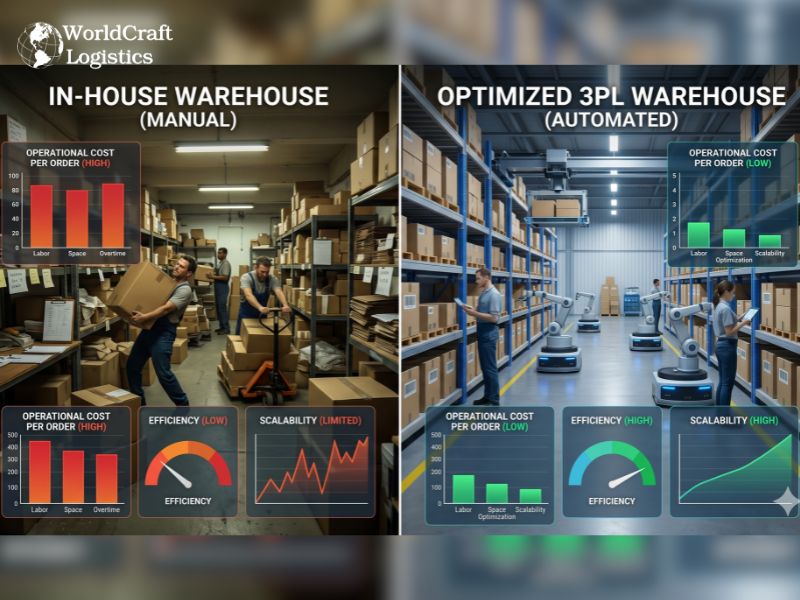
Deciding when to transition from a garage or a small private warehouse to a professional 3rd party logistics provider is a pivotal moment for any scaling brand. In 2026, the DIY approach to fulfillment is increasingly difficult due to the complexity of carrier integrations and the high cost of industrial real estate.
Historically, the tipping point for outsourcing was roughly 100 to 200 orders. However, in 2026, the benchmark has shifted to 500 orders per month.
Below 500 Orders: In-house fulfillment is often more cost-effective if you have free space (like a home office or retail backroom) and your own labor.
Above 500 Orders: The opportunity cost of your time plus the lack of volume-based shipping discounts makes in-house fulfillment more expensive than 3PL pricing.
Efficiency isn't just about the 3PL cost per order; it's about operational agility. You should consider a 3PL partner when:
In 2026, the most successful brands treat fulfillment as a variable cost. By moving to a 3PL, you convert the fixed drag of a warehouse lease into a flexible 3PL pricing model that scales down when you're quiet and up when you're booming.
Worldcraft Logistics provides a high-performance fulfillment ecosystem designed to simplify global trade. We focus on four core advantages:
Understanding why quotes vary is essential for building a realistic logistics budget. In 2026, 3PL fulfillment pricing is driven by six primary variables:
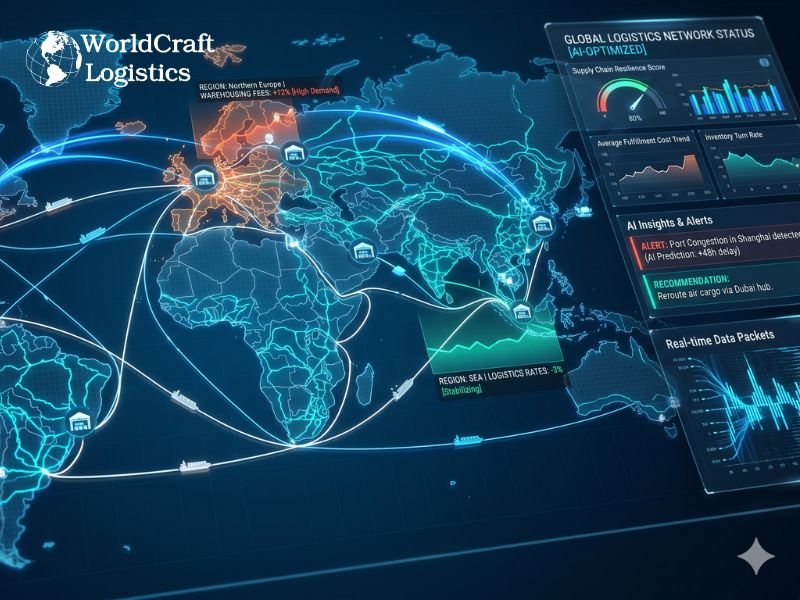
The logistics landscape in 2026 is defined by rapid technological adoption and shifting consumer expectations. To maintain competitive 3PL pricing, providers are pivoting toward automation and hyper-local distribution. Here are the four trends currently reshaping the industry:
The average 3PL cost per order typically ranges from $10.00 to $16.00. This includes the pick and pack fee ($2.50–$3.50), storage, packaging materials, and the final-mile shipping cost.
In 2026, most businesses pay between $18.00 and $40.00 per pallet per month. For brands with smaller items, cubic foot warehouse pricing averages $0.45 to $0.60 per cubic foot.
Often, yes. While FBA offers speed, their 2026 Inbound Placement Fees and steep Low-Inventory Level Fees make a multi-channel 3PL like Worldcraft Logistics a more cost-effective choice for brands selling across multiple platforms.
Standard pick and pack rates for 2026 are $2.00–$3.00 for the first item and $0.30–$0.75 for each additional item in the same order.
Use this formula: (Total Monthly 3PL Fees / Total Orders) + Average Shipping Cost. This gives you a clear Landed Cost per Order for your unit economics.
This is the cost to offload and log your inventory into the WMS. In 2026, this is billed at $5–$15 per pallet or $35–$55 per hour for floor-loaded containers.
Yes. Processing a return is labor-intensive. Expect to pay between $3.50 and $6.00 per return, which covers inspection and restocking.
The General Rate Increase (GRI) is the annual base rate hike implemented by carriers like UPS and FedEx. In 2026, the average increase is 5.9%.
Yes. High-volume 3PLs like Worldcraft Logistics aggregate millions of shipments to negotiate deep discounts with carriers, which are then passed on to you.
Carriers charge based on the space a package occupies or its actual weight, whichever is greater. 3PLs use automated dimensioners to help you optimize packaging and avoid these surcharges.

SEO
Digital Marketing/SEO Specialist
Simon Mang is an SEO and Digital Marketing expert at Wordcraft Logistics. With many years of experience in the field of digital marketing, he has shaped and built strategies to effectively promote Wordcraft Logistics' online presence. With a deep understanding of the logistics industry, I have shared more than 500 specialized articles on many different topics.
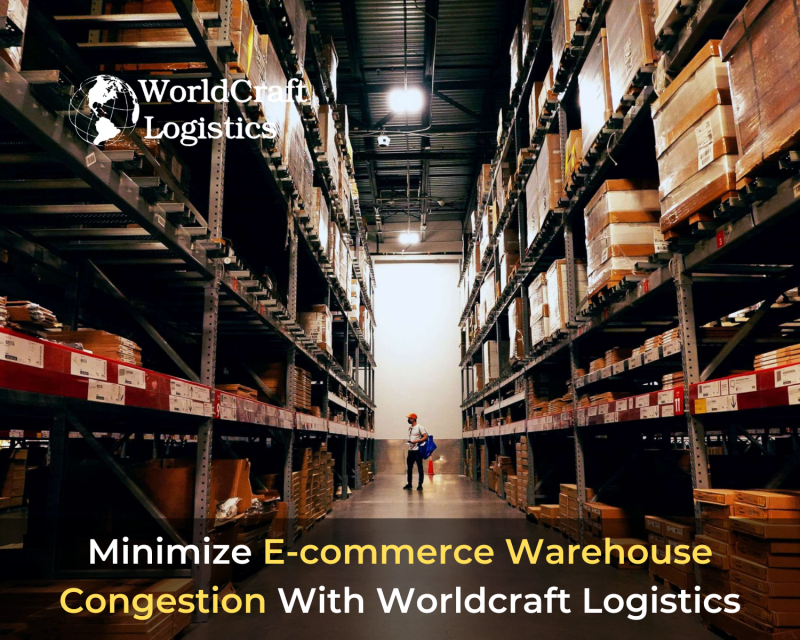
3PL - Third Party Logistics
05/14/2024
3PL - Third Party Logistics
03/29/2023
3PL - Third Party Logistics
03/20/2023
3PL - Third Party Logistics
03/30/2023
3PL - Third Party Logistics
05/12/2023