
Starting June 1st, 2023 Our warehouse fee will be $0.65/cubic foot per month
In effort to lower the warehouse storage fee during inflation, we have went narrow aisle racking.This construction took us four months but the project is finally completed. With narrow aisle racking, we are able to drop storage by 24%.We as partners will go through this inflation together.
12/15/2025
Backorders are a common yet costly challenge in today’s competitive e-commerce environment. This guide explains what backorders mean, how they differ from out-of-stock items, and outlines key causes, risks, and practical strategies such as safety stock planning and supplier lead-time management to protect revenue and maintain customer trust.
What is a backorder? A backorder is an order placed by a customer for a product that a retailer does not currently have in stock, but expects to receive from the supplier and fulfill at a later, specified date. In the dynamic landscape of e-commerce and retail, maintaining perfect inventory is a persistent challenge. The concept of a backorder is central to managing temporary supply chain disruptions and unexpected demand spikes.
Unlike an out-of-stock item, where the retailer may not know when or if the product will return, a backorder signifies a committed transaction. The seller accepts the payment (or a commitment) and guarantees future delivery, essentially selling inventory that is in transit or scheduled for production. This operational status is crucial for businesses as it allows them to capture revenue immediately, maintain customer loyalty for high-demand items, and manage cash flow effectively even during temporary shortages. This strategy contrasts with simply canceling the order or losing the sale entirely.
Backorders are not random operational failures but the result of identifiable weaknesses within demand planning, inventory strategy, and supply chain execution. In practice, backorders often emerge when businesses are caught between volatile customer demand and rigid supply constraints. Understanding the underlying causes allows companies to move from reactive firefighting to proactive risk management. While some factors are unavoidable, many backorders can be mitigated through better forecasting, tighter inventory controls, and stronger supplier coordination.
Irregular or abnormal surges in demand remain one of the most common triggers of inventory shortages. Even well-optimized forecasting models can struggle when sales volumes dramatically exceed historical patterns, increasing the likelihood of backorders.
These demand shocks often stem from sudden exposure. Examples include strong seasonality effects, viral media coverage, appearances on high-profile platforms such as Shark Tank or Good Morning America, recognition from authoritative lists like TIME Magazine’s Best Inventions, or a celebrity endorsement that drives massive traffic overnight. Additionally, launching a new sales channel can significantly expand reach faster than inventory can scale. In such cases, existing safety stock is rapidly depleted, leaving fulfillment teams unable to meet incoming orders.
Safety stock exists to absorb uncertainty across demand fluctuations and supply disruptions. When safety stock levels are underestimated or poorly maintained, even normal purchasing behavior can outpace available inventory. This structural weakness frequently leads to backorders, not because demand is excessive, but because the buffer stock was never sufficient to begin with.
Effective inventory management requires continuous recalibration of safety stock calculations. Factors such as supplier reliability, lead time variability, historical demand volatility, and sales velocity must be reviewed regularly. Businesses that rely on static safety stock models expose themselves to higher fulfillment risk during even minor disruptions.
External supply chain disruptions remain a primary and often uncontrollable cause of inventory shortages.
Production halts can occur when manufacturers experience raw material shortages, factory shutdowns, labor constraints, or extended holiday closures such as the Chinese New Year. Any interruption at the production level directly cascades downstream, forcing retailers to delay fulfillment and manage customer expectations.
Lead time volatility compounds this risk. Even with timely reordering, fluctuating supplier lead times, especially during global supply chain disruptions, can exhaust safety stock faster than anticipated. When replenishment shipments fail to arrive as scheduled, businesses are left with no choice but to place products into backorders.
Not all fulfillment issues originate outside the organization. In many cases, internal process gaps and human error are the root cause.
Manual mistakes such as delayed replenishment decisions, failure to pause online listings for out-of-stock SKUs, or inaccurate stock counts can result in overselling inventory that does not physically exist. These errors are particularly common in high SKU or fast-moving environments.
Warehouse management discrepancies further exacerbate the issue. Inventory may be misplaced, damaged, expired, or incorrectly recorded during routine operations. If warehouse management systems fail to detect these discrepancies in real time, businesses may unknowingly sell unavailable products, creating artificial backorders that erode customer trust and operational efficiency.
When a customer places an order for a product that is temporarily out of stock, the transaction transitions into a structured backorder fulfillment workflow. Unlike standard order processing, backorders require a higher level of coordination between inventory systems, suppliers, and customer communication to preserve trust and operational efficiency. A clearly defined process ensures that delayed orders are fulfilled accurately and in the correct sequence once inventory becomes available.
The customer confirms the purchase after being clearly informed that the item is on backorder. At this stage, the system captures or authorizes payment and flags the order as pending inventory replenishment, officially entering it into the backorders queue.
The inventory management system assigns the next available inbound unit to the earliest qualifying order. This allocation logic is essential to ensure fairness and prevent newer orders from bypassing customers who have already been waiting.
The retailer coordinates closely with suppliers to accelerate replenishment where possible. Once inbound inventory reaches the warehouse, it is immediately received, verified, and staged for fulfillment to minimize additional delays.
Orders on backorder are fulfilled ahead of standard in-stock orders. The warehouse team processes the shipment promptly, and the customer receives a shipping confirmation with tracking details, signaling the successful resolution of the backorders cycle.
Transparent communication is one of the most decisive factors in successful backorder management. Customers are generally willing to wait as long as expectations are clearly set and consistently updated.
Initial Notification: Immediately after checkout, customers should receive a confirmation email clearly stating the backorder status and the most accurate Estimated Time of Arrival (ETA) available at that moment.
Ongoing Status Updates: If supply conditions change, businesses must proactively update customers. Whether timelines improve or extend, honest communication reduces frustration and lowers cancellation risk. Overly optimistic ETAs often result in broken trust and negative feedback tied to backorders.
Clear Cancellation Options: Customers should always be informed of their right to cancel at any time for a full refund. This transparency reinforces brand credibility and demonstrates respect for the customer’s purchasing decision.
The efficiency of managing delayed orders depends heavily on the tracking system in place.
Manual Tracking: Spreadsheet-based tracking relies on human intervention and is prone to data inaccuracies, delayed updates, and inventory misallocation. This approach is only viable for businesses with minimal order volume and rare backorders.
Automated Tracking: Modern Inventory Management Systems (IMS) or ERP platforms automate allocation logic, monitor inbound stock, prioritize fulfillment by order date, and trigger customer notifications automatically. These systems dramatically reduce errors, improve fulfillment speed, and provide full visibility across all backorders, making them essential for scaling operations.
Don't let backorders erode your customer trust. Worldcraft Logistics provides fully automated supply chain management solutions, helping you track inventory, prioritize product allocation, and fulfill orders seamlessly. Contact us today to turn the backorder challenge into an opportunity to build brand loyalty.
>>> Read more: Shipping Dates & Delivery Dates: Differences & Importance Explained
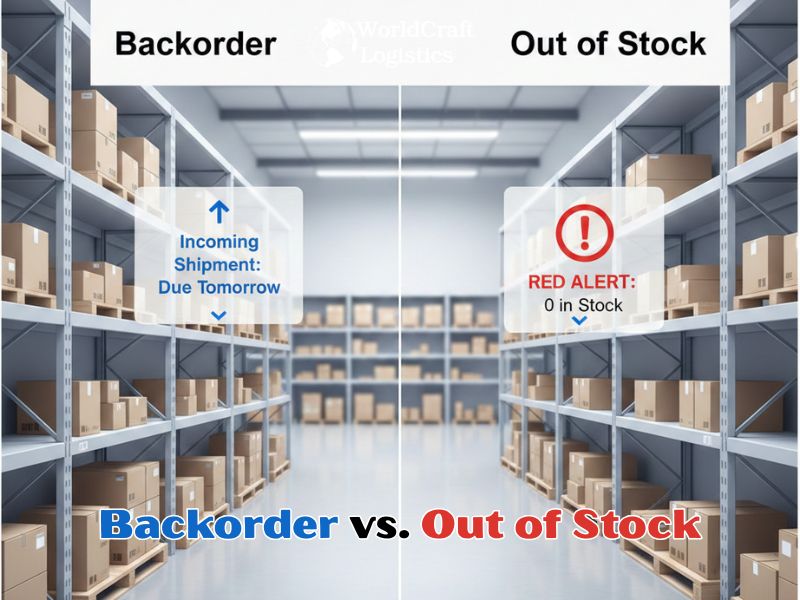
Although backorder and out of stock both signal temporary product unavailability, they represent two fundamentally different inventory states with very different implications for revenue, customer trust, and operational planning. Confusing these terms can distort demand forecasting, weaken customer communication, and lead to costly inventory decisions. Understanding the distinction is essential for any business managing dynamic inventory flows and customer expectations.
The most critical difference between backorder and out of stock lies in the sales commitment already made.
Status | Commitment | Customer Action | Financial Impact |
Backorder | Yes (Sale Made): The retailer has accepted the order and committed to future fulfillment upon inventory arrival. | Customer pays now and waits. | Revenue is secured immediately. |
Out of Stock | No (Sale Lost): The retailer cannot accept the order; the product page typically shows "unavailable." | The customer must wait for the item to become available, or leave to shop elsewhere. | Revenue is lost or postponed. |
From an inventory management perspective, backorders represent pre-sold inventory. Each unit is already allocated to a specific customer and must be fulfilled once replenishment arrives. This requires precise inbound inventory planning and allocation logic.
By contrast, an out-of-stock item reflects unrealized demand. The product has no committed buyer, and the business must focus on restocking speed, demand recapture, or competitor risk mitigation.
Inventory status directly influences how customers perceive both the product and the brand.
Out of Stock: This status often triggers immediate abandonment. Customers face uncertainty around availability and timelines, increasing the likelihood they will purchase from a competitor. The emotional response is typically frustration and loss of confidence.
Backorder: While waiting is required, the presence of a confirmed order and a clearly communicated ETA provides reassurance. Customers are often willing to wait for high-demand, specialized, or trusted products. Transparent handling of backorders allows businesses to retain both the customer relationship and the sale.
The financial treatment of each status differs significantly and affects internal reporting accuracy.
Backorder Accounting: Revenue from backorders is typically recognized early from a sales perspective, improving short-term performance metrics. However, accounting teams must carefully track the outstanding fulfillment obligation until the product ships to avoid misreporting liabilities.
Out of Stock Accounting: This status represents lost or deferred revenue. Sales teams cannot count the transaction, and recovery efforts shift toward tools such as back-in-stock notifications, waitlists, or promotional follow-ups to recapture demand.
Accurately classifying inventory as backorder or out of stock ensures cleaner financial reporting, better forecasting, and more effective sales prioritization, especially in high-volume or fast-moving supply chains.
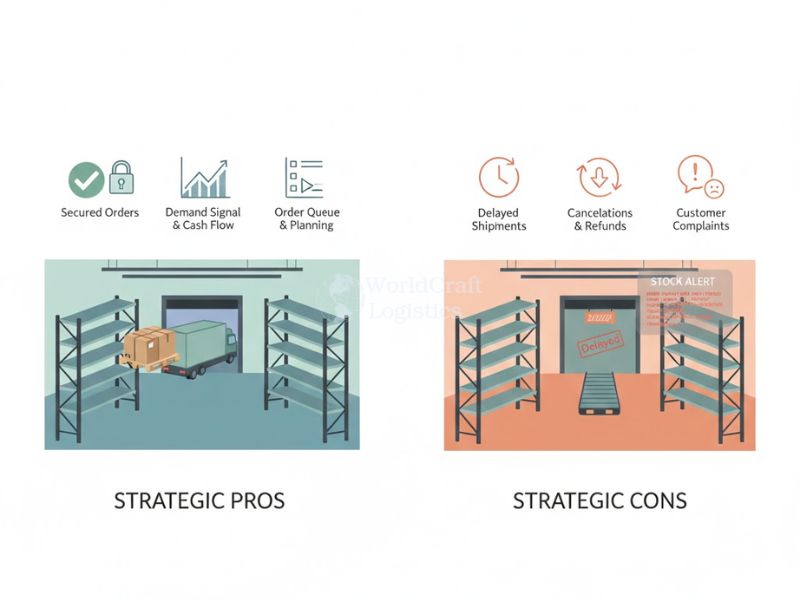
The decision to sell products on backorder is a double-edged sword. While it offers significant strategic and financial advantages, it also carries inherent risks to customer goodwill and operational stability. A balanced strategic analysis is necessary before adopting this fulfillment method.
When used deliberately, a backorder strategy can deliver meaningful competitive advantages, especially for high-demand or seasonal products.
Securing Customer Commitment: Selling on backorder allows businesses to lock in the sale at the moment of peak customer intent. Instead of losing the customer to a competitor due to temporary unavailability, the retailer secures payment or authorization and preserves the relationship. This makes backorders a powerful tool for customer retention during inventory gaps.
Validating Product Demand: Recurring backorders serve as concrete, real-time indicators of unmet demand. Unlike forecasts or historical data alone, these confirmed orders provide actionable insight into how much customers are willing to buy, helping businesses refine production planning, reorder quantities, and inventory investment decisions.
Improved Cash Flow and Inventory Efficiency: By capturing revenue earlier in the sales cycle, businesses can improve short-term cash flow and fund replenishment more effectively. At the same time, operating with controlled backorders supports leaner inventory models, lowering storage costs and reducing exposure to overstock or obsolete inventory.
Despite their benefits, backorders introduce operational and customer-facing risks that must be carefully managed.
Customer Frustration and Cancellation Risk: Extended wait times or frequently changing ETAs can erode customer trust. If expectations are not set clearly from the outset, customers may become dissatisfied, leading to higher cancellation rates, refund requests, and negative reviews, particularly when delays feel uncertain or poorly explained.
Increased Administrative Load: Handling backorders alongside regular orders adds complexity across the fulfillment operation. Teams must accurately track inbound inventory, allocate stock by order priority, and respond to a higher volume of customer inquiries. Without automated systems, backorders can significantly increase manual workload and the risk of fulfillment errors.
While backorders are dreaded, unplanned, and sometimes inevitable, implementing proactive stock control measures is the most effective way to reduce the likelihood of them occurring. By focusing on smart planning and advanced inventory tracking, businesses can significantly improve fulfillment reliability.
While backorders are often viewed as disruptive and unavoidable, most occurrences can be significantly reduced through proactive stock control and disciplined inventory planning. By combining accurate forecasting, real-time visibility, and structured replenishment rules, businesses can improve fulfillment reliability and protect customer trust even during periods of demand volatility.
One of the most effective defenses against fulfillment delays is maintaining sufficient safety stock. E-commerce businesses must rely on inventory management systems that provide real-time stock visibility to prevent overselling and customer disappointment.
A reorder point (ROP) defines the exact inventory threshold at which a new purchase order should be triggered. Establishing accurate ROPs is essential for preventing inventory gaps before they impact fulfillment.
The Formula: The reorder point is calculated by combining lead-time demand with safety stock, ensuring replenishment begins before inventory reaches a critical low.
Execution: Once stock levels hit the predefined ROP, the system automatically signals the need to reorder. Many e-commerce fulfillment platforms and third-party logistics providers offer built-in tools that calculate ROPs and send alerts, reducing reliance on manual oversight and minimizing the likelihood of backorders.
Accounting for Peaks: Reorder logic should always factor in upcoming promotions, flash sales, product launches, or media exposure. Historical sales data can be used to temporarily increase reorder quantities during high-velocity sales events such as Cyber Monday or seasonal campaigns.
No inventory plan is immune to real-world variation. Fast-moving and high-demand products require closer monitoring than slow-selling SKUs. Regular inventory reviews allow businesses to make timely purchasing decisions and avoid unexpected sellouts. Maintaining visibility over top-performing products is critical to preventing avoidable backorders that can erode customer confidence.
Supplier dependency is a major contributor to extended fulfillment delays. Relying on a single manufacturer exposes businesses to production halts, long lead times, and unforeseen disruptions.
By adopting a supplier diversification strategy, businesses can activate backup production sources when primary suppliers fail to deliver on time. This flexibility strengthens supply chain resilience and significantly reduces the duration and frequency of backorders caused by external disruptions.
While ordering large quantities may reduce the risk of stockouts, it introduces substantial financial and operational inefficiencies. Excess inventory can:
Overwhelm warehouse capacity
Increase carrying costs such as storage, insurance, and tied-up capital
Limit cash flow flexibility for marketing, product development, or expansion
*Note on Carrying Costs:
Inventory carrying costs vary based on product type, SKU count, warehouse location, turnover rate, and fulfillment model (in-house vs. outsourced). Calculating the true cost per unit, beyond the purchase price, is essential for finding the optimal balance between inventory availability and capital efficiency. The goal is not to eliminate backorders, but to manage inventory in a way that minimizes them without compromising financial health.
Customer acceptance of delayed shipping depends less on logic and more on emotion, fairness, and trust. When facing backorders, customers subconsciously weigh the perceived value of the product against the frustration of waiting. If the item feels unique or difficult to replace, tolerance increases; if the brand has a history of missed delivery promises, patience quickly disappears.
Clear and proactive communication is the most effective way to manage this psychological tension. Retailers must disclose delays and realistic ETAs before payment, provide frequent updates even when timelines slip, and offer an easy cancellation with a full refund. This transparency restores a sense of control, reduces anxiety, and helps preserve customer goodwill despite the delay.
Accepting delayed orders may protect short-term revenue, but backorders often generate hidden costs that extend well beyond the initial sale. As wait times increase, cancellation and refund requests rise, forcing businesses to absorb non-refundable payment processing fees, additional administrative labor, and the long-term loss of repeat customers, directly impacting profit margins.
Beyond financial strain, poorly managed backorders pose a serious reputational risk. Negative reviews, declining conversion rates, and the need to expedite shipping or absorb premium delivery costs to appease customers can quickly erode both brand trust and overall profitability, sometimes turning a secured sale into a net operational loss.

How to master the balance of supply and demand? Successfully managing backorders is a critical balancing act between demand capture and customer trust. While accepting a backorder secures revenue and validates high demand, the true cost lies in the risk of delayed shipping and reputational damage. By prioritizing transparent communication, investing in accurate demand forecasting, and optimizing safety stock levels, businesses can transform backorders from a crisis into a controlled, strategic fulfillment method. Ultimately, mastering the art of prevention and professional handling ensures your business captures every sale without sacrificing customer loyalty.

SEO
Digital Marketing/SEO Specialist
Simon Mang is an SEO and Digital Marketing expert at Wordcraft Logistics. With many years of experience in the field of digital marketing, he has shaped and built strategies to effectively promote Wordcraft Logistics' online presence. With a deep understanding of the logistics industry, I have shared more than 500 specialized articles on many different topics.
Education
01/05/2025
Education
02/18/2025

Education
01/01/2024
Education
09/09/2025
Education
08/28/2024