08/19/2026
For a growing clothing brand, order fulfillment quietly decides whether you scale smoothly or drown in boxes. Apparel fulfillment, also called clothing 3PL, lets a third-party partner store your inventory, pick and pack your orders, and handle returns, so you can focus on designing and selling. This guide explains what clothing fulfillment services include, the apparel-specific challenges a good 3PL solves, what it costs, and how Worldcraft Logistics can even bring your product in from the factory abroad and fulfill it from one partner.
Apparel fulfillment, also called clothing 3PL, is when a third-party logistics provider stores a clothing brand's inventory and picks, packs, and ships its orders on the brand's behalf.
In practice, a clothing fulfillment service receives your stock, stores it in a warehouse, and then fulfills each order as it comes in from your online store, marketplace, or wholesale accounts. It is the operational backbone that turns a sale into a package on a customer's doorstep.
Not every provider is the same, though. A basic fulfillment center handles domestic pick and pack, while a full apparel 3PL adds value-added services, returns management, and, in the strongest cases, the freight and customs to import your product in the first place. Fashion fulfillment demands more care than most categories, which is why choosing the right partner matters.
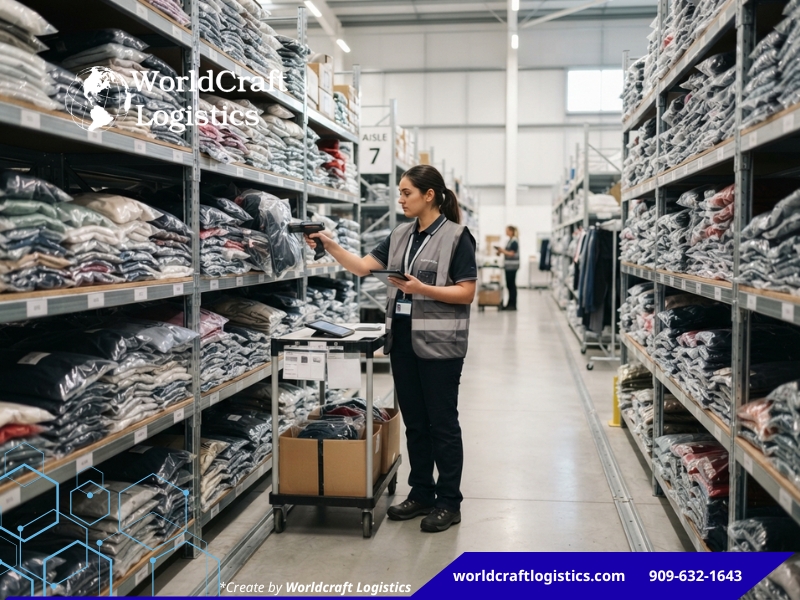
A clothing fulfillment service covers receiving, storage, pick and pack, returns, and value-added work such as tagging, steaming, poly-bagging, and kitting.
The best clothing fulfillment services manage your product across its whole journey, not just the moment it ships. The core components are below.
| Service | What it does |
|---|---|
| Receiving & inspection | Checks inbound stock against the purchase order and logs it by SKU, size, and color. |
| Storage | Holds inventory on shelves, in bins, or on hangers, organized for fast, accurate picking. |
| Pick & pack | Picks the right size and color for each order and packs it in branded or standard packaging. |
| Returns management | Receives, inspects, and restocks or disposes of returned apparel, a high-volume task in fashion. |
| Value-added services | Tagging, steaming, folding, poly-bagging, kitting, and branded or gift packaging. |
| Amazon FBA prep | Labeling and prep so apparel meets Amazon requirements before it ships to a fulfillment center. |
| Omnichannel fulfillment | Fulfills direct-to-consumer, marketplace, and retail or wholesale orders from one inventory pool. |
Because apparel sells across many channels at once, look for a 3PL that can serve your website, your marketplaces, and your retail accounts from a single stock pool. For sellers on Amazon, prep is its own discipline, explained in our guide to Amazon FBA prep in the Bay Area.
Worldcraft Logistics provides apparel fulfillment and warehousing from three FDA-registered fulfillment centers in California: Ontario, Union City, and Cerritos.
Our California network gives your apparel fast reach across the West Coast and access to both major gateways: the Port of Oakland in Northern California, near our Union City facility, and the Ports of Los Angeles and Long Beach in Southern California, near our Ontario and Cerritos facilities. Across all three sites, we handle the full operation behind your clothing brand: receiving and inspection, secure storage, accurate pick and pack, returns processing, kitting, and Amazon FBA prep.
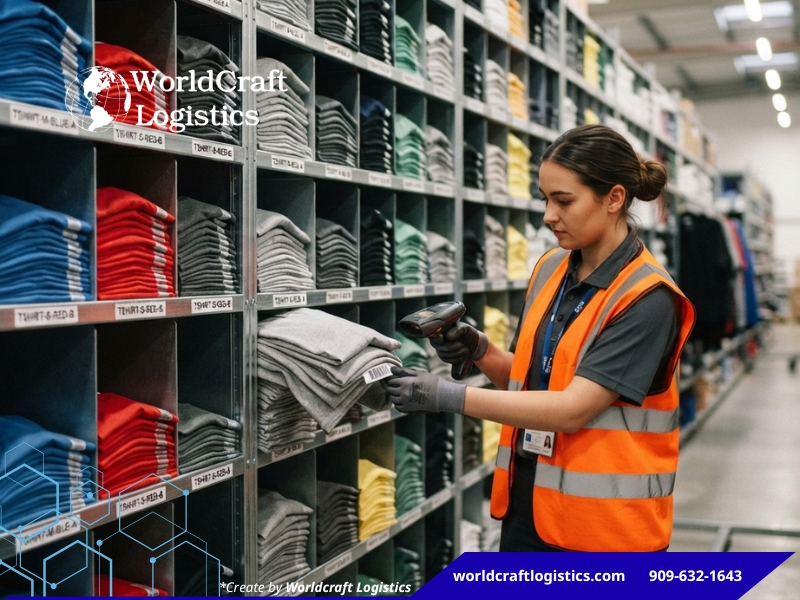
Because we are also a freight forwarder, we can receive your apparel straight from an import container and move it into fulfillment with fewer handoffs, which lowers cost and speeds up your restock. Our pricing is usage-based and transparent, so you can budget with confidence rather than guessing at hidden fees. For more on our Northern California operation, see our guide to Bay Area warehousing.
Ready to hand off fulfillment? Get an apparel fulfillment quote from Worldcraft Logistics →
The biggest apparel fulfillment challenges are SKU complexity from size and color variants, seasonal demand spikes, and high return rates.
Clothing is one of the hardest categories to fulfill accurately, and a specialist apparel 3PL is built to handle exactly these problems.
An import-capable apparel 3PL can ship your clothing from Asia, clear customs, and fulfill orders from one partner, which standard domestic fulfillment centers cannot do.
Most clothing brands manufacture overseas, often in Vietnam, China, or elsewhere in Asia, and then hand their freight, customs, and fulfillment to three different vendors. Every handoff adds cost, delay, and risk. A 3PL that is also a freight forwarder collapses that chain into one.
The end-to-end flow looks like this: your apparel leaves the factory by ocean or air freight, arrives at the Port of Oakland or the Ports of Los Angeles and Long Beach, clears customs, is received at one of our nearby California warehouses in Ontario, Union City, or Cerritos, and then ships to your customers as orders come in. Handling it all with one partner, across both Northern and Southern California ports, lowers your total landed cost and shortens the time from factory to shelf. This is the core advantage Worldcraft Logistics offers over a fulfillment-only provider, and it is especially valuable for brands importing from Vietnam and Asia.
In-house fulfillment gives you control but ties up cash, space, and labor, while an apparel 3PL turns that into a scalable, variable cost, and usually wins once you ship a few hundred orders a day.
The decision comes down to how much time and capital you want to spend on operations versus product and growth. The comparison below covers the trade-offs.
| Factor | In-house fulfillment | Apparel 3PL |
|---|---|---|
| Cost model | Fixed rent, labor, and equipment | Variable, scales with orders |
| Scalability | Limited by your space and staff | Flex up or down by season |
| Peak seasons | You hire and manage temp labor | Handled by the 3PL |
| Technology | You buy and run a WMS | Included and integrated |
| Your focus | Split between ops and growth | On product and sales |
| Best for | Very low volume or full-control needs | Growing, seasonal, or import-driven brands |
As a rule of thumb, outsourcing to a clothing 3PL becomes worthwhile once your own team can no longer pick, pack, and ship accurately at your order volume, which for many brands is around a few hundred orders a day.
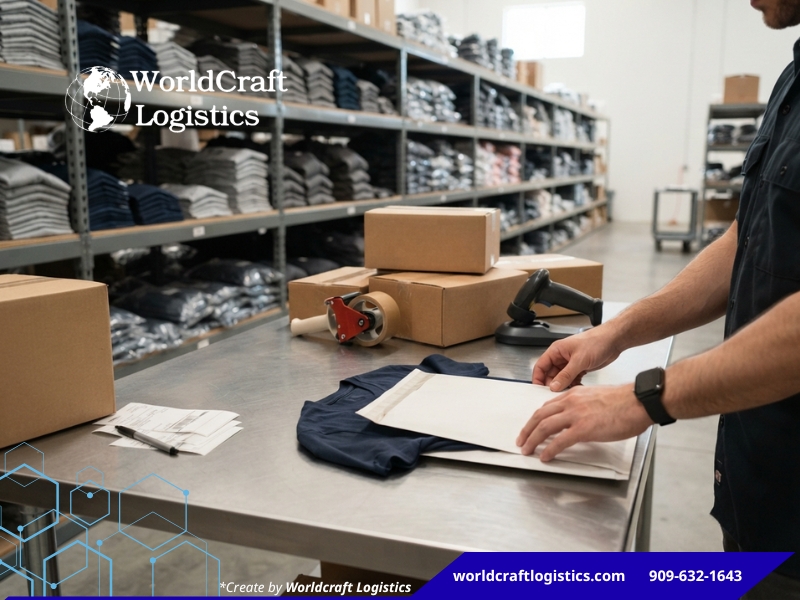
Clothing fulfillment is usually priced per order for pick and pack, around $2 to $4 for the first item plus per-item fees, along with storage of about $15 to $30 per pallet per month.
Fulfillment is usage-based, so you pay for the services you actually use rather than a flat monthly lease. As a reference, Bay Area apparel fulfillment costs break down like this.
| Service | Indicative range (US)* | Notes |
|---|---|---|
| Pallet storage | $15 to $30 per pallet / month | Or per bin for small SKUs |
| Receiving | $15 to $30 per pallet | Inbound handling |
| Pick & pack (first item) | $2.00 to $4.00 per order | Base fulfillment fee |
| Each additional item | $0.30 to $1.00 per item | Scales with order size |
| Value-added (steaming, tagging, kitting) | $25 to $40 per labor hour | Quoted per project |
| Returns processing | $2 to $5 per return | Adds up for high-return categories |
* Indicative US reference ranges only, not a quote. Actual pricing depends on your product, volume, and services, so request a quote. Our California 3PL cost guide breaks the numbers down further.
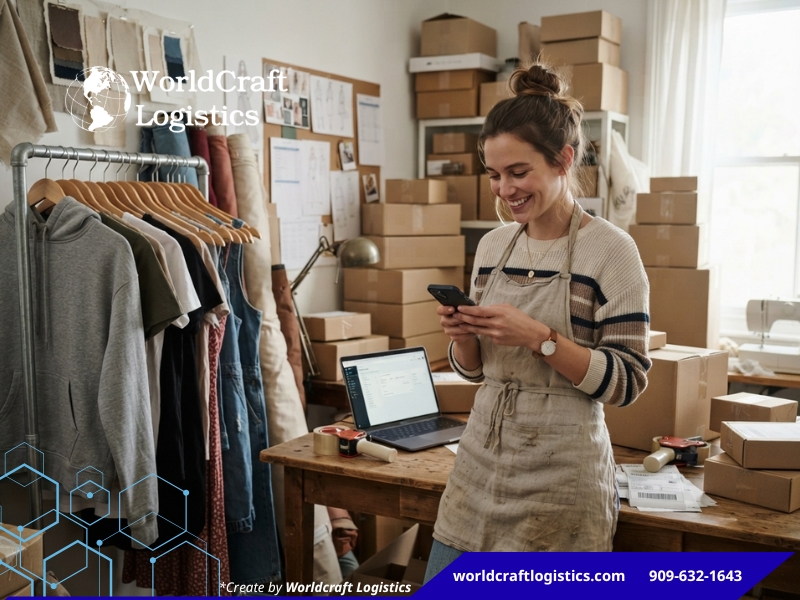
Choose an apparel 3PL on its handling of size and color SKUs, returns, seasonal flexibility, integrations, transparent pricing, and whether it can manage your imports.
Because apparel is so operationally demanding, the right partner matters far more than the lowest quote. A cheap 3PL that mis-picks sizes, mishandles returns, or buckles during your peak will cost you more in lost sales and refunds than it ever saves in fees. Treat each of the criteria below as a real test, not a checkbox, and ask candidates to prove it rather than just claim it.
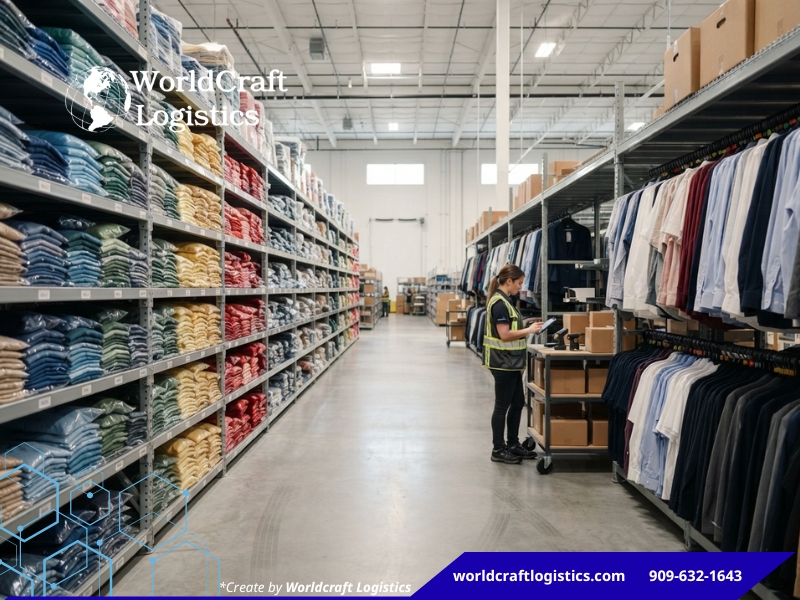
Beyond the theory, the same situations come up again and again in the founder communities and forums where clothing brands compare notes on fulfillment. Here is what each looks like in practice and how the right 3PL resolves it.
Most brands start by packing orders themselves from a garage, a spare room, or a small studio, and it works well until it doesn't. As sales climb, packing starts to eat the hours that should go into design, marketing, and sourcing, small picking mistakes creep in, and shipping falls behind during a busy week. This is the single most common tipping point brands describe, and it is usually the moment to move to a 3PL. Handing off receiving, storage, and pick and pack frees the founder to grow the business while orders keep shipping accurately and on time.
A brand that has simply run out of room, with inventory stacked in every corner and no space for a new season, needs storage and labor at the same time. A 3PL solves both as a single flexible service: your stock moves into a proper warehouse, and the same team that stores it also fulfills your orders. That removes the scramble to find extra space before each launch, and it ends the overselling that happens when a brand can no longer see its true stock levels.
Fashion brands increasingly compete on the unboxing experience, so plain, generic packing undercuts everything they spend on marketing. These brands want steaming, careful folding, branded tissue and inserts, and a consistent presentation on every single order. A specialist apparel 3PL delivers those value-added touches at scale, so the experience a customer gets from order number one thousand looks exactly like the one they got from order number ten.
A brand manufacturing in Vietnam, China, or elsewhere in Asia often juggles a freight forwarder, a customs broker, and a fulfillment center as three separate vendors, paying at every handoff and losing visibility in the gaps. Consolidating with a 3PL that is also a freight forwarder lets one partner import the goods, clear customs, and fulfill the orders, which shortens lead times, reduces the total landed cost, and gives the brand a single point of contact for the whole journey.
Apparel fulfillment is where a clothing brand either scales or stalls. The right clothing 3PL takes on the hardest parts of the operation, from size-and-color accuracy to returns and seasonal peaks, so you can put your energy into product and growth. Worldcraft Logistics goes a step further by combining freight, customs, and fulfillment across three California locations: Ontario, Union City, and Cerritos, so your apparel can move from the factory abroad to your customer's door with one partner and no unnecessary handoffs.
Most apparel 3PLs ship orders received before a daily cutoff on the same or next business day. Ask each provider for its order cut-off time and same-day or next-day shipping rate, and how those hold up during peak season.
Yes. A good clothing 3PL connects directly to Shopify, WooCommerce, marketplaces like Amazon, and retail EDI, so orders flow in automatically and you see live inventory. Confirm which integrations are native versus custom before you sign.
It varies by provider. Some 3PLs set a monthly minimum spend or a minimum order count, while others take brands of any size. Ask about minimums up front so a slow month does not leave you paying for capacity you did not use.
A 3PL absorbs seasonal spikes by scaling space and labor up for your peak and back down afterward, so you are not staffing for your busiest week all year. Ask how much extra volume they can handle and how far in advance they need your forecast.
Yes. Value-added services such as branded boxes, tissue, inserts, tagging, folding, and steaming let a clothing 3PL match your unboxing experience on every order. These are usually quoted as add-ons, so ask for the per-order cost.
Yes. An omnichannel apparel 3PL fulfills direct-to-consumer, marketplace, and wholesale or retail orders from one inventory pool, often with

SEO
Digital Marketing/SEO Specialist
Simon Mang is the SEO and Digital Marketing Specialist at Worldcraft Logistics, where he leads content strategy to promote the company's online presence. With years of experience in digital marketing and a strong understanding of the logistics industry, he has published more than 500 specialized articles across freight, warehousing, and supply chain topics. ( Reviewed for accuracy by the Worldcraft Logistics Operations Team ).