08/17/2026
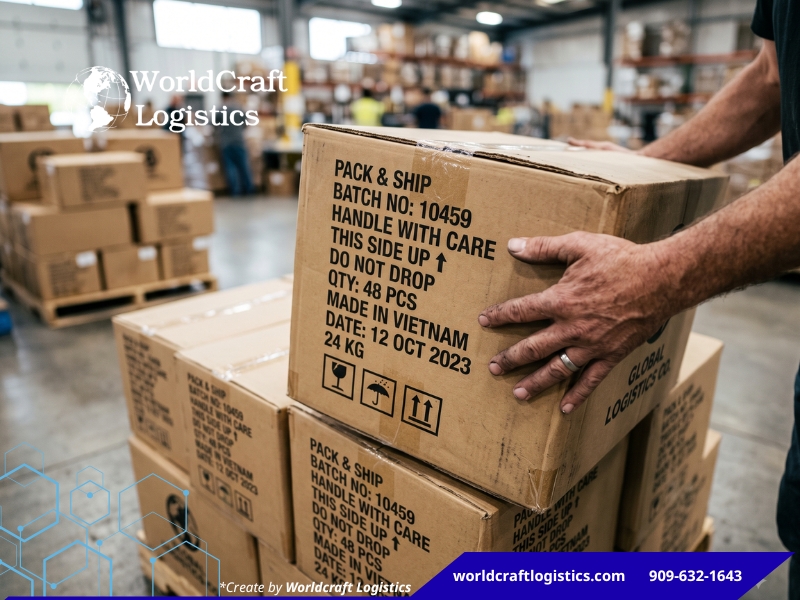
If a shipment arrives at a warehouse with no carton marking on it, warehouse staff cannot tell what is inside, and every box may need to be opened just to find one style, color or size. That single problem is why carton marking exists, and it is the starting point for this guide.
Carton marking is the complete set of text information and handling symbols printed or stencilled on the outside of a shipping carton, so that anyone handling the box, anywhere in the world, understands what it contains and how it must be treated. This guide covers both parts of carton marking, the text based details and the graphical ISO 780 symbols, plus Amazon FBA rules and real examples from a Worldcraft Logistics warehouse walkthrough.
Carton marking, also called a shipping mark or carton label, is the identifying information placed on the outside of a shipping carton to identify its contents, weight, dimensions, origin and handling requirements. It exists so that freight forwarders, customs officers, warehouse staff and delivery drivers can identify and handle a shipment correctly without opening it.
Carton marking generally covers two things at once. Text-based marking identifies who the goods belong to, what they are, and how much they weigh. Graphical symbols under the ISO 780 standard tell handlers how to treat the carton physically, such as keeping it upright or away from moisture, without relying on any one language.
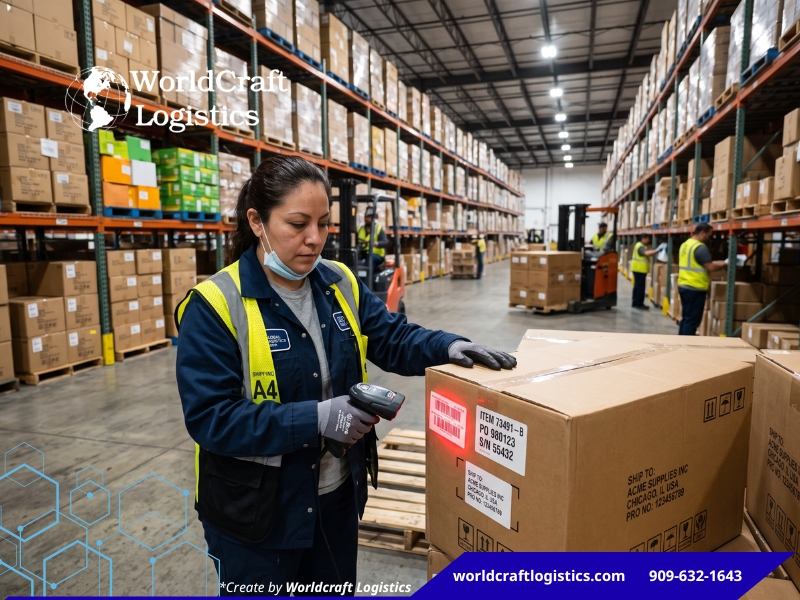
In practice, the clearest way to see why this matters is a real example from the warehouse floor.
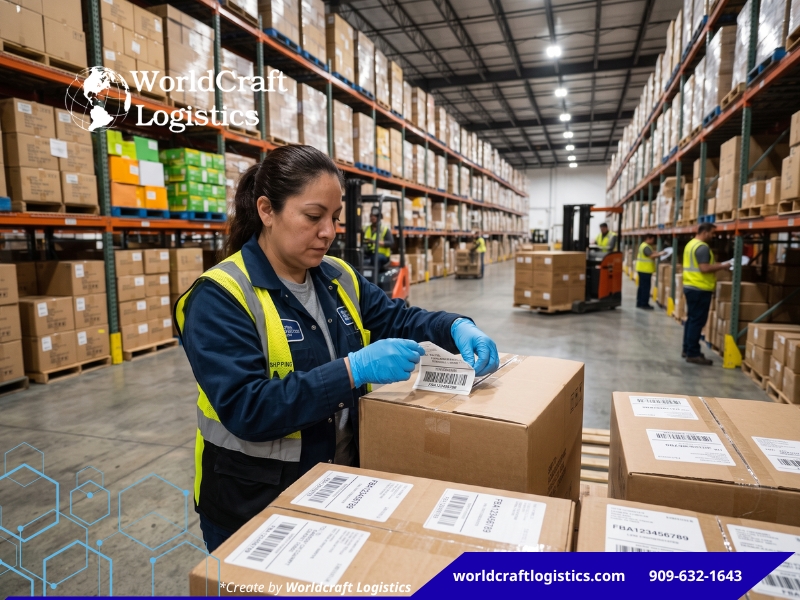
In a Worldcraft Logistics warehouse walkthrough, our team demonstrated carton marking using an actual television shipment. That single carton makes every required text field easy to picture, so it is used as the running example below.
The consignee's company name, and where relevant the shipper's return address, should appear clearly on the carton. This is the first thing warehouse staff and customs check to confirm who a shipment belongs to.
The product name or SKU identifies exactly what is inside without opening the box. For a shipment with several product variants, such as different shoe colors or sizes, this field is what prevents the wrong variant from being picked or shipped.
Marking how many units are inside, such as one television per carton, lets staff and customers confirm contents at a glance. In the Worldcraft example, the carton was marked for a quantity of one television unit.
Net weight is the weight of the product alone, and gross weight includes the carton and packaging materials. Marking both means the carton never has to be reweighed at each stage of the shipping process, since everyone handling it already knows exactly how heavy it is.
Length, width and height, usually in centimeters, let warehouses and carriers plan space in a container, truck or storage rack, and are also used to calculate volumetric weight for freight pricing.
Country of origin, for example, Made in China, is required by most customs authorities to assess duties and confirm trade compliance. If the same product ships to more than one country, the origin marking should match the correct destination market.
When a shipment spans multiple cartons, each box should be numbered as part of the set, for example, 29 of 100. This series count is what confirms an entire shipment has arrived together, and immediately flags a missing carton if the count does not add up.
For high-value or high theft risk products, such as electronics, cameras or branded goods, some shippers use blind marking, where the true product name is replaced on the outside of the carton with an agreed code name known only to the shipper and consignee. This reduces the risk of theft or tampering at ports and warehouses, but the code must be agreed in advance and changed periodically to stay effective.
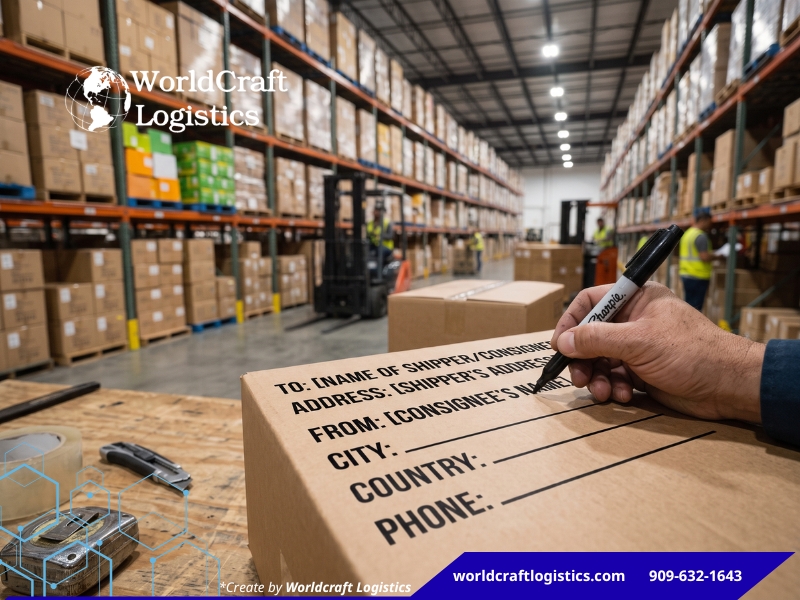
ISO 780:2015 is the international standard that defines graphical handling symbols for distribution packaging. These pictograms remove the language barrier entirely, so a carton handled in any country is understood the same way. The table below covers the symbols most commonly seen on commercial shipments.
| Symbol Name | Visual Cue | Meaning |
|---|---|---|
| Fragile Handle With Care | Contents can break easily | Handle gently, do not drop or throw |
| This Side Up | Two arrows pointing up | Keep carton in the upright position shown |
| Keep Dry | Umbrella over drops | Protect from rain, moisture and wet storage areas |
| Stacking Limitation By Number | Boxes with a number n | Maximum number of identical cartons that may be stacked on top |
| Do Not Use Hand Truck Here / No Hooks | Hook with a cross through it | Do not lift or drag the carton using a hook |
| Do Not Roll | Circle with a cross through it | Carton must not be rolled on its side |
| Temperature Limitation | Thermometer symbol | Keep within a stated temperature range during transport and storage |
| Sling Here | Chain or rope loop icon | Marks the correct point to attach lifting slings |
| Center Of Gravity | Target with crossed lines | Marks the carton's balance point for safe lifting |
A carton does not need every symbol on this list. Only the symbols that apply to the actual product and its real handling requirements should be used, since unnecessary symbols add clutter and reduce how quickly handlers notice the ones that matter.
The WorldCraft Logistics warehouse example above used several of these symbols on the same carton at once: handle with care, keep dry, this side up, a maximum stack of two, no hooks, and do not roll, since the television inside was fragile, moisture-sensitive, and needed to stay upright.
Shipments going into an Amazon Fulfillment By Amazon warehouse follow Amazon's own labeling rules on top of standard carton marking.
Ideally, the supplier applies Amazon's official FBA label to each carton before it ships. If the supplier cannot do this, the carton or unit must instead be marked with the FNSKU, Amazon's Fulfillment Network Stock Keeping Unit, so Amazon's system can identify the inventory correctly on arrival.
Two real situations from Worldcraft's own warehouse operations show how strict Amazon's rules are in practice. In one shipment, a supplier used a yellow strapping band around each carton to make loading and unloading easier and to hold a heavy product in place inside a weak paper box. Amazon does not accept this band and requires it to be removed before the carton can be received. In another shipment, a supplier wrapped cartons in white plastic film because the carton itself was too flimsy to hold the product without it. Amazon does not accept this either, and issues a warning to the seller.
In both cases, the real fix is not the wrapping. It is a stronger carton from the factory, since Amazon expects the box itself, not tape, bands or film, to keep the product secure.
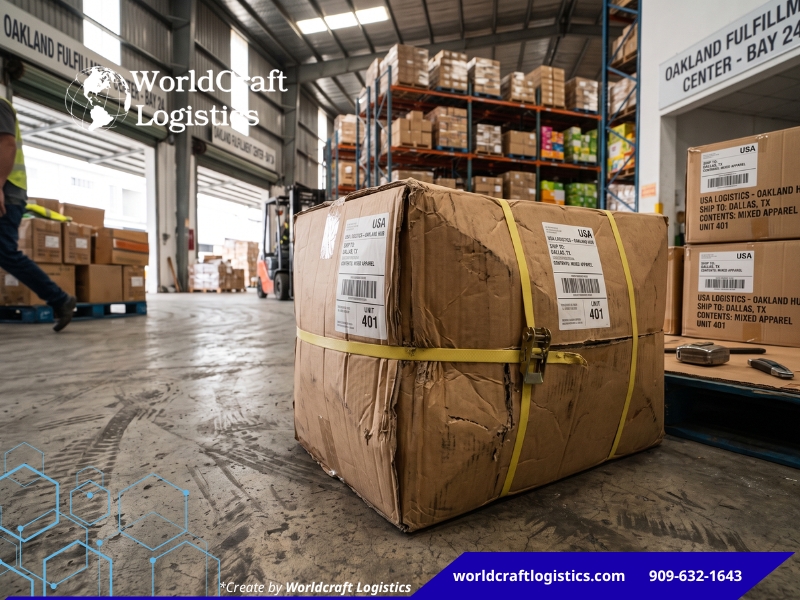
Even shippers who understand the rules above still lose time and money to a handful of repeating mistakes. Most of these do not show up until the carton is already in transit or sitting at a warehouse dock, which makes them expensive to fix. Here are the five most common ones seen across real shipments.
The most common mistake is choosing a carton grade that cannot support the weight or shape of the product inside, then trying to compensate with strapping bands, tape or plastic film. This almost never works as intended. Bands can jam automated receiving equipment, plastic wrap gets rejected outright by strict destinations like Amazon FBA, and a carton that flexes or bulges in transit is far more likely to split open or crush the product beneath it in a stack. The fix is always the same: upgrade to a stronger corrugated grade at the factory rather than reinforcing a box that was never rated for the load.
When a shipment spans many cartons, for example, fifty or a hundred boxes for a single order, each carton should be numbered as part of the set, such as 29 of 100. Shippers often skip this to save time on labeling, but without it there is no simple way to confirm that every carton from the original shipment actually arrived. A missing box can sit unnoticed for weeks, since nothing on the remaining cartons flags that the count is short. This becomes especially costly for high value goods, where a missing carton can mean a missing pallet of inventory with no paper trail pointing to where it was lost.
Inconsistent marking, different fonts, different placements, or some cartons marked in one language and others in a different one, forces warehouse staff to read each box individually instead of scanning a shipment at a glance. This slows down receiving and sorting significantly, and it is a common problem when a shipment is packed across multiple production runs or by more than one factory line without a shared marking template. Standardizing one format, one placement, and one set of required fields before packing begins removes this problem entirely.
Reusing cartons is common and generally fine, but old shipping marks, barcodes and handling symbols from the previous shipment need to be fully removed or blacked out first. A leftover label from an earlier consignee, product code or destination creates real confusion for warehouse staff and can even trigger a carton being misrouted to the wrong customer or held for manual verification. This is a small step that is frequently forgotten under time pressure at the packing stage.
ISO 780 symbols and text-based marking are meant to work together, not as substitutes for each other. A carton with handling symbols but no consignee, SKU or weight information cannot be identified or routed. A carton with full text details but no handling symbols may be stacked, rolled or dropped in ways that damage a fragile or moisture-sensitive product, since the symbols are what communicate that instantly to handlers who do not read the shipper's language. Every carton should carry both, matched to what the product actually needs.
Carton marking problems are usually caught too late, after the shipment has already left the factory and arrived at a warehouse or port with symbols missing, weight fields blank, or an unauthorized wrap that a destination like Amazon will reject on sight. Worldcraft Logistics builds a review step directly into the process at our California warehouses in Ontario, Cerritos and Union City, so these issues are caught and corrected before they turn into a shipping delay or a rejected delivery.

When cargo arrives, our team inspects each carton against the marking requirements for its destination, whether that is standard customs documentation, retailer-specific labeling, or Amazon FBA rules. If marking is missing, incorrect or uses a format Amazon does not accept, such as strapping bands or plastic film, we can correct it, apply new labels, or replace the FBA label and FNSKU marking directly on site, rather than sending the shipment back to the factory or leaving it to be rejected at receiving.
Alongside marking correction, Worldcraft Logistics also offers:
The goal is simple: a marking or packaging problem caught at our warehouse should never become a missed delivery window, a rejected FBA shipment, or a customs delay at the border.
Contact Worldcraft Logistics to review your carton marking and packaging before your next shipment leaves the factory.

SEO
Digital Marketing/SEO Specialist
Simon Mang is the SEO and Digital Marketing Specialist at Worldcraft Logistics, where he leads content strategy to promote the company's online presence. With years of experience in digital marketing and a strong understanding of the logistics industry, he has published more than 500 specialized articles across freight, warehousing, and supply chain topics. ( Reviewed for accuracy by the Worldcraft Logistics Operations Team ).