07/16/2026
In the fast-paced world of modern supply chains, Artificial Intelligence (AI) is often hailed as the ultimate silver bullet. From dynamic route optimization to end-to-end predictive tracking, global logistics companies are in a high-stakes race to integrate AI into their operational workflows.
Yet, a harsh reality remains: nearly 95% of AI Proof of Concept (PoC) initiatives fail not because the underlying technology is weak, but because of poor application design, dirty data, and a lack of human adoption.
At Worldcraft Logistics, we evaluate digital assets and emerging tech through a highly practical lens. To ensure your organization doesn't fall into the costly trap of funding dead-end AI projects, let's dissect the core mistakes of AI implementation and map out a realistic path to true supply chain ROI.
Many logistics businesses are enticed by plug-and-play wrapper tools and shallow AI solutions that are incredibly easy to launch but only address minor corner cases rather than resolving core operational bottlenecks.
Look at the sudden collapse of numerous AI startups following OpenAI's native system updates. Many of these businesses saw their valuations plunge to zero overnight because their products were merely thin wrappers built on third-party foundational models. Conversely, dedicated systems like Harvey AI which was engineered specifically for the complex workflows of legal professionals, continue to thrive because they solve deep, industry-specific pain points.
Never start by searching for a massive, singular AI model to solve everything. Begin instead with high-frequency, repeatable use cases that sit at the very center of your daily operations. Successfully streamlining these repetitive tasks establishes the baseline measurements you need to scale up securely.
To explore how to properly structure your business architecture before diving into digitization, take a look at our curated Global Supply Chain Best Practices, where we share years of hands-on logistics expertise.
While "100% autonomous supply chains" remain a distant goal due to legacy data silos and fragmented shipping systems, AI is already delivering massive, highly measurable financial returns in two main areas:
Historically, manual processing of Bills of Lading (BOLs), Proofs of Delivery (PODs), and carrier invoices has been a primary source of costly back-office friction.
Real-World Case Study: Rather than relying on a single large language model, the most effective approach is deploying an ensemble of fit-for-purpose models. Each specialized micro-model handles a partitioned problem space (e.g., one model decodes contract language, while another cross-checks financial line items).
The Bottom Line: Using this multi-model architecture allows logistics teams to automate tens of thousands of PODs per week with extreme precision, successfully slashing carrier and billing disputes by over 50%.
In Less-Than-Truckload (LTL) shipping, PRO numbers are frequently plagued by human data-entry errors, leading to severe headaches during accounts receivable and accounts payable (AR/AP) reconciliation. When a specialized LLM is trained on historical data patterns, it can flag and self-correct poorly entered PRO data right at the start of the shipment lifecycle, saving hours of manual audit work down the line.
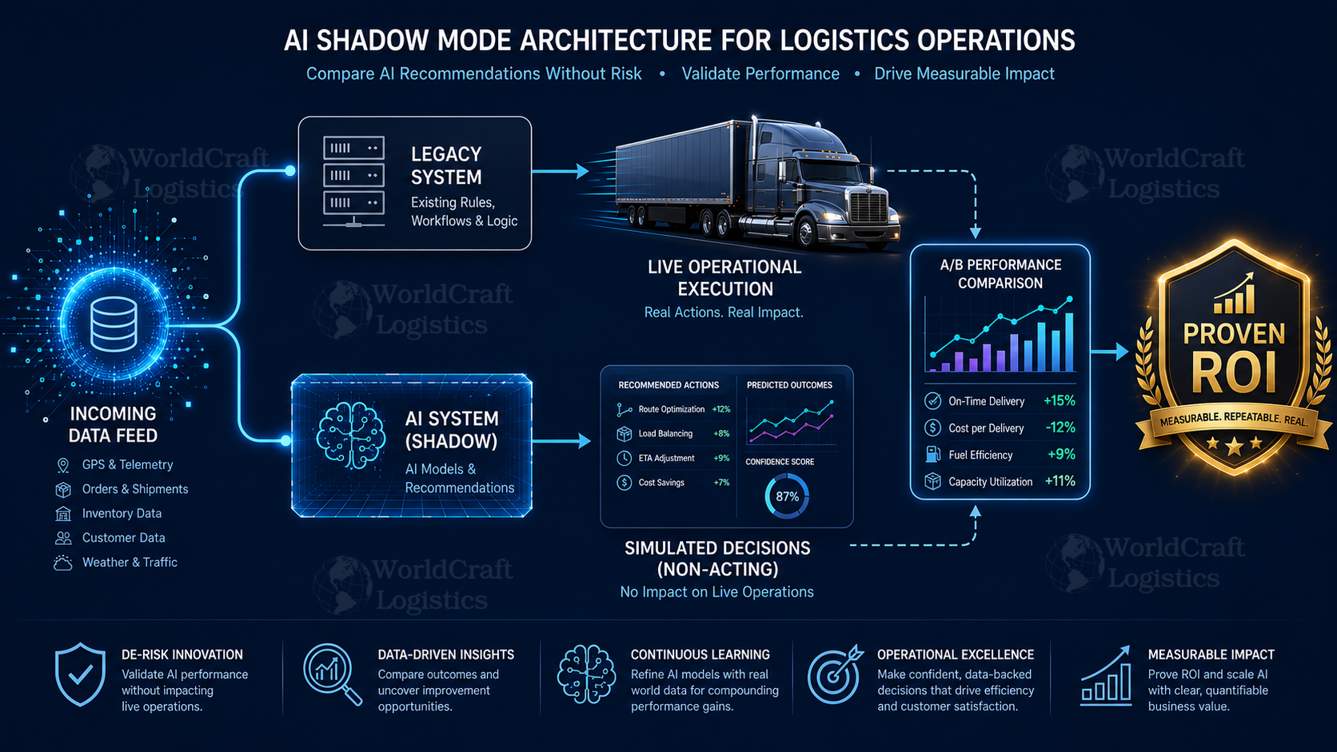
How do you prove that an expensive new AI model actually outperforms your traditional, time-tested systems without risking your live operations? The answer lies in running the system in Shadow Mode.
Instead of immediately cutting over to a new system, "Shadow Mode" lets the AI run silently in parallel with your existing software without executing live commands:
For Example: When testing an AI-driven truckload dispatching or route planning tool, your legacy system continues to run the actual fleet. Meanwhile, the AI generates its own routing proposals based on live traffic, weather, and shipment data.
The Result: This provides a clean, risk-free A/B comparison. You can mathematically verify if the AI-driven recommendations would have reduced empty miles or fuel consumption before officially deploying the software.
Technology is only as powerful as the team running it. To bypass the 95% failure rate associated with user friction and poor adoption, supply chain leaders must utilize this 5-step framework:
Avoid Chatbot Fatigue: The absolute last thing your dispatchers and logistics coordinators need is a fragmented array of individual chatbots interrupting their focus. AI capabilities must be integrated seamlessly into the user experience (UX) of their existing software.
Maintain a Human-in-the-Loop Protocol: In logistics, the cost of failure is incredibly high (delayed medical shipments, factory shutdowns, expensive port demurrage). AI should act as a highly intelligent assistant making recommendations, while experienced humans retain final decision-making power.
Ensure Data Readiness First: AI cannot generate smart outputs if it is continuously fed unstructured, stale, or poorly digitized data. Companies must clean, structure, and digitize their historical shipping records before attempting to train any advanced models.
Enforce Strict Data Governance & Provenance: When partnering with external software vendors, you must have ironclad agreements regarding data privacy. Ensure your proprietary supply chain data remains completely secure, is never used to train public models, and can be fully deleted upon request.
Build a Culture of Collaborative Iteration: Bring your operations team into the development process early through hackathons or feedback loops. When your frontline staff is actively involved in designing the tools, they will champion their adoption rather than resisting the transition.
Based on the latest industry benchmarks curated by AI Productive Lab, here is a comprehensive breakdown of the ten most effective AI tools designed to optimize modern supply chain and freight operations:
| Num. | AI Logistics Tool | Best For | Core Capability | Ideal User |
|---|---|---|---|---|
| 1 | FourKites | Shipment Visibility | Real-time multimodal tracking and predictive ETA alerts to proactively mitigate transit delays. | Shippers, retail supply chain leaders, and manufacturers |
| 2 | Project44 | Predictive Analytics | High-accuracy multimodal shipment intelligence to reduce dwell times and eliminate port congestion issues. | Enterprise logistics and freight forwarding teams |
| 3 | Optimal Dynamics | Truckload Freight Planning | Automated dispatching and mathematical load planning to maximize driver and fleet utilization. | Truckload carriers and asset-based fleets |
| 4 | Kinaxis | Supply Chain Planning | Advanced demand forecasting, inventory optimization, and automated scenario modeling for disruptions. | Large manufacturers and Consumer Packaged Goods (CPG) companies |
| 5 | Symbotic | Warehouse Automation | AI-driven autonomous robotics orchestrated to handle high-volume picking, packing, and sorting. | Large-scale distribution centers and mega-retailers |
| 6 | ClearMetal by project44 | Ocean Freight Forecasting | Highly accurate predictions for vessel arrivals, container availability, and maritime transit windows. | Ocean importers and global freight forwarders |
| 7 | Coupa | Spend Management | Automated procurement, corporate spend optimization, and supplier financial risk monitoring. | Global procurement, sourcing, and finance teams |
| 8 | Locus | Last-Mile Route Optimization | Dynamic routing algorithms that factor in traffic, driver schedules, and narrow delivery windows. | E-commerce brands, couriers, and last-mile delivery fleets |
| 9 | Flexport | Global Freight Forwarding | Technology-driven international shipping, automated customs workflows, and carbon emission analytics. | Mid-sized global importers and exporters |
| 10 | ParkourSC | Supply Chain Risk Monitoring | Real-time monitoring of geopolitical, weather, and infrastructure events mapped against active shipping lanes. | Global supply chain directors and risk managers |
AI is not a magic wand that will transform your business overnight; it is an ongoing process of strategic iteration. As advanced technologies like Agentic AI and unified machine-to-machine communication protocols continue to evolve, the ability to surgically upgrade legacy systems is becoming easier than ever before.
At Worldcraft Logistics, we don't buy into overhyped, fully autonomous fantasies. Instead, we focus on delivering real-world, highly reliable supply chain execution, combining masterfully managed data with the seasoned expertise of our global transport network.
Ready to identify the hidden inefficiencies in your current transport strategy? Contact the Worldcraft Logistics Specialist Team today. If you are ready to optimize your upcoming shipments, simply request a tailored Custom Logistics Solution Quote to discover how we can drive measurable efficiency into your global supply chain.

SEO
Digital Marketing/SEO Specialist
Simon Mang is the SEO and Digital Marketing Specialist at Worldcraft Logistics, where he leads content strategy to promote the company's online presence. With years of experience in digital marketing and a strong understanding of the logistics industry, he has published more than 500 specialized articles across freight, warehousing, and supply chain topics. ( Reviewed for accuracy by the Worldcraft Logistics Operations Team ).