
08/18/2026
Lithium batteries power almost everything we ship today, from phones and laptops to e-bikes, power tools, and electric vehicles, which is exactly why learning how to ship lithium batteries safely and legally matters so much. They are also one of the most tightly regulated products in freight, because a damaged or poorly packed battery is a genuine fire risk. This guide explains the regulations, packaging, labels, carrier policies, and costs for shipping lithium batteries internationally, so your shipment moves without delays, fines, or rejection.
Lithium battery rules change often. The figures here are based on the US PHMSA Lithium Battery Guide (2024) and IATA guidance and are provided for general education. Always confirm the current IATA DGR, ICAO, IMDG Code, and DOT 49 CFR requirements, and your carrier's own policy, before you ship.
Yes, you can ship lithium batteries internationally, but they are Class 9 dangerous goods and must follow IATA, IMDG, and DOT rules for packaging, labeling, and documentation.
Lithium batteries are not banned, but they are restricted. Whether a shipment is straightforward or heavily regulated depends on two things: the type of battery and how it is shipped. Batteries shipped on their own are treated more strictly than batteries installed inside a device, because a loose battery carries a higher risk of short circuit. Small batteries below certain watt-hour limits qualify for lighter requirements, while larger ones are fully regulated dangerous goods.
The mode of transport matters just as much. Standalone lithium-ion batteries are forbidden on passenger aircraft and can only travel on cargo aircraft, while ocean and ground transport allow more flexibility. Because lithium batteries are dangerous goods, shipping them also overlaps with wider hazmat rules.

For the broader picture on dangerous goods, see our guide to shipping hazardous materials.
Yes. Lithium batteries are hazardous materials in Class 9 (miscellaneous dangerous goods), and they are assigned one of four UN numbers depending on type and packing.
Every lithium battery shipment must be identified with the correct United Nations (UN) number and proper shipping name. This is the single most important step in classifying your shipment, because it drives the packaging, labels, and paperwork that follow. There are four UN numbers for lithium batteries.
| UN Number | Battery Type | How It Is Shipped |
|---|---|---|
| UN3480 | Lithium-ion | Standalone batteries shipped by themselves |
| UN3481 | Lithium-ion | Packed with, or contained in, equipment |
| UN3090 | Lithium metal | Standalone batteries shipped by themselves |
| UN3091 | Lithium metal | Packed with, or contained in, equipment |
Lithium-ion batteries are the rechargeable type found in phones, laptops, and e-bikes. Lithium metal batteries are usually non-rechargeable, such as the coin cells in watches and small electronics. Getting the UN number right is the foundation of a compliant lithium battery shipping process, so confirm it before you package or label anything.
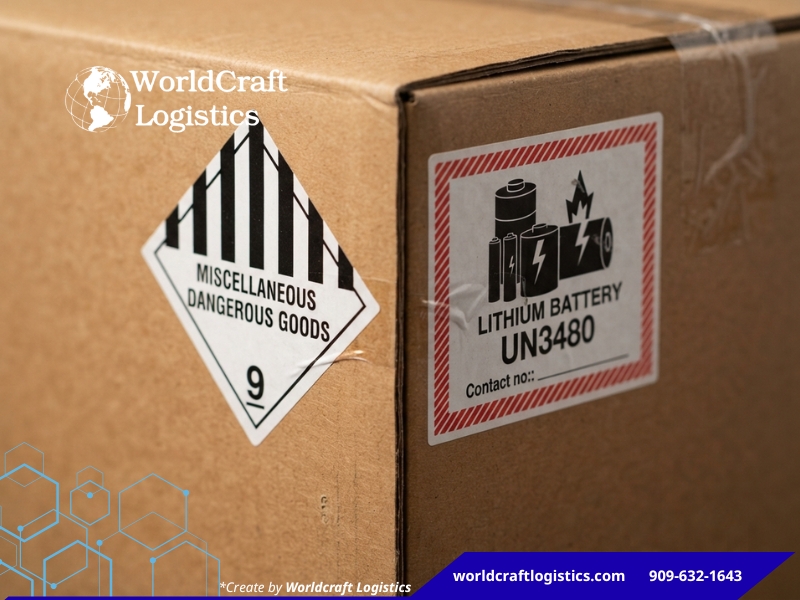
Lithium battery shipping is governed by the IATA DGR for air, the IMDG Code for sea, and DOT 49 CFR for US road, each with its own restrictions, with air being the strictest.
There is no single global rulebook. Instead, each transport mode has its own regulations, all built on the UN Model Regulations. Understanding which set applies to your shipment is essential.
| Mode | Governing Rules | Key Points |
|---|---|---|
| Air | IATA DGR / ICAO Technical Instructions | Strictest. Standalone lithium-ion (UN3480) batteries are forbidden on passenger aircraft; standalone batteries shipped by cargo aircraft are subject to a 30% state-of-charge limit, with full labeling and declaration requirements. |
| Sea | IMDG Code | Class 9 handling, ventilation, and cargo segregation. Generally more permissive than air and often the best option for large or bulk shipments. |
| Road (US) | DOT 49 CFR (PHMSA) | Hazmat rules apply to ground transportation. Road transport is often the least restrictive mode domestically, although lithium batteries remain regulated. |
These frameworks come from official sources. For US ground and general guidance, the PHMSA Lithium Battery Guide (2024) is the authoritative reference, and for air transport the IATA lithium battery guidance sets the standard. Always work from the current edition, because thresholds and packing instructions are updated regularly.

The main lithium battery shipping restrictions are watt-hour (Wh) limits, a 30% state-of-charge cap for air cargo, quantity limits per package, and a ban on damaged batteries.
Size is what separates a lightly regulated shipment from a fully regulated one. Lithium-ion capacity is measured in watt-hours (Wh), and lithium metal by the grams of lithium it contains. Batteries at or below the thresholds in the table qualify for reduced requirements, while anything above is fully regulated Class 9.
| Battery Type | Reduced Requirement Threshold* | Above the Threshold |
|---|---|---|
| Lithium-ion Cell | 20 Wh or less | Fully regulated |
| Lithium-ion Battery | 100 Wh or less | Fully regulated Class 9 |
| Lithium Metal Cell | 1 g lithium or less | Fully regulated |
| Lithium Metal Battery | 2 g lithium or less | Fully regulated |
* Widely published thresholds for reference; confirm the current IATA and DOT values before shipping.
Two more restrictions matter for air shipments in particular. First, standalone lithium-ion batteries must be shipped at a state of charge (SoC) of 30 percent or less, which reduces fire risk in transit. Second, there are limits on how many batteries and how much net weight you can put in each package. And in every mode, batteries that are damaged, defective, or recalled face separate, much stricter rules, covered later in this guide.

To package lithium batteries for shipping, use UN38.3-tested cells, protect every terminal against short circuits, use strong non-metallic inner packaging, and use UN-specification outer packaging for fully regulated shipments.
Packaging is where most lithium battery shipments succeed or fail an inspection. The goal is simple: prevent short circuits, movement, and crushing. Good packaging follows a few clear rules.
A test summary confirming UN38.3 compliance has been required to be available for lithium battery shipments since 2022, so make sure your supplier can provide it. Well-packaged batteries not only pass inspection, they also protect the rest of your cargo.

Lithium battery shipments require the Class 9 lithium battery hazard label, the lithium battery mark, the UN number and proper shipping name, and, for fully regulated shipments, a Shipper's Declaration for Dangerous Goods.
Correct marks and paperwork tell every handler what is inside and how to treat it. The requirements scale with how regulated your shipment is, but the core elements are consistent.
Documentation errors are one of the most common reasons a lithium battery shipping request is delayed or rejected, so it is worth having a dangerous goods-trained person prepare and check the paperwork.
Major carriers accept lithium batteries under their dangerous goods programs, but policies differ: USPS is the most restrictive, while FedEx, UPS, and DHL accept fully regulated shipments under a dangerous goods agreement.
Even when a shipment meets the regulations, each carrier applies its own policy on top, and these change often. The table below is a general guide only.
| Carrier | General Stance on Lithium Batteries* |
|---|---|
| FedEx | Accepts fully regulated lithium shipments under an approved dangerous goods agreement, with strict packaging and paperwork. |
| UPS | Accepts lithium shipments; fully regulated shipments usually need a contract or pre-approval, while smaller excepted shipments are more flexible. |
| USPS | The most restrictive. Domestically, it generally allows only batteries installed in equipment within limits, and it prohibits many standalone and international air lithium shipments. |
| DHL | Accepts lithium batteries under its dangerous goods program, subject to compliance and route restrictions. |
* General guidance only; carrier rules vary by service, route, and change frequently. Always confirm current policy directly with the carrier or your freight forwarder before booking.
A dangerous goods experienced forwarder can route your shipment through the carrier and mode that will actually accept it.
Damaged, defective, or recalled lithium batteries are forbidden on aircraft and are subject to special, much stricter rules for any transport, because they carry the highest fire risk.
A battery that is swollen, leaking, overheating, or has been recalled is treated very differently from a new, compliant one. These batteries are prohibited from air transport entirely, and moving them by other modes requires special provisions, approved packaging designed to contain a thermal event, and often prior approval.
Used and second-hand lithium batteries can usually be shipped if they are undamaged and still meet the standard rules, but you must confirm their condition and, where required, their UN38.3 status. If you are unsure whether a battery is safe to ship, treat it as damaged and get expert advice rather than risk a dangerous, non-compliant shipment.

Shipping lithium batteries typically adds a dangerous goods surcharge of about $100 to $250 per shipment by air (or roughly $150 to $500 per container by sea), plus $20 to $60 for UN-specification packaging and $50 to $150 for documentation, on top of the base freight rate.
There is no flat rate, because the total cost depends on the battery type, quantity, transport mode, and how regulated the shipment is. As a reference, the extra costs specific to lithium batteries usually break down like this:
| Cost Component | Indicative Range (US)* | Notes |
|---|---|---|
| DG surcharge (air) | $100 to $250 per shipment | Added on top of base air freight |
| DG surcharge (ocean) | $150 to $500 per container | Lower per unit for bulk |
| DG surcharge (courier/parcel) | $50 to $180 per package | Varies by carrier and battery section |
| UN-specification packaging | $20 to $60+ per box | Vs a few dollars for a standard carton |
| Documentation (Shipper's Declaration) | $50 to $150 per shipment | Sometimes billed as a service |
| Base air freight | ~$4 to $9 per kg (international) | Cargo-only routing for standalone batteries |
* Indicative US reference ranges only, not a quote. Actual pricing varies by carrier, route, battery type, quantity, and current fuel and DG rates.
The main extra costs to plan for are:
As a general rule, ocean freight is the most economical option for large or bulk lithium battery shipments, while air is faster but carries the highest surcharges. Because the variables are so specific, the only accurate figure is a quote for your exact shipment.
Beyond the rules, the same practical situations come up again and again. Here is how each is typically handled.

Shipping a battery already installed in a device, such as an e-bike, follows its own guidance, covered in our guide to shipping an electric bike.
Choose a freight forwarder with proven dangerous goods experience, trained staff who can classify and document lithium batteries, and the carrier and mode options to actually move your shipment.
Because lithium batteries are dangerous goods, the partner you choose matters more than with ordinary freight. Judge candidates on these points:
Worldcraft Logistics moves regulated and general cargo across global trade lanes, with air, ocean, and customs services that support dangerous goods shipments handled in accordance with applicable rules. If you are importing batteries or battery-powered products, the right forwarder turns a complex, high-risk shipment into a predictable one.

Learning how to ship lithium batteries comes down to a few essentials: classify the battery with the correct UN number, respect the watt-hour and state-of-charge limits, package to prevent short circuits, apply the right labels and documentation, and work within each carrier's policy. Get those right and lithium batteries move safely and legally around the world. Get them wrong and you risk fines, rejection, or a genuine safety incident. When in doubt, verify the current regulations and lean on a dangerous goods experienced partner.
Talk to Worldcraft Logistics
Worldcraft Logistics provides air, ocean, and customs services for importers moving lithium batteries and battery-powered products across global trade lanes, handled to the applicable dangerous goods rules. Get a lithium battery shipping quote:
Talk to our freight team →Yes. Lithium batteries are Class 9 dangerous goods (miscellaneous), assigned UN3480 or UN3481 for lithium-ion and UN3090 or UN3091 for lithium metal, depending on whether they ship alone or in equipment.
Yes, but with strict limits. Standalone lithium-ion batteries (UN3480) are forbidden on passenger aircraft and may only travel by cargo aircraft at 30 percent state of charge or less, with full labeling and declaration.
Lithium batteries are Class 9, the class for miscellaneous dangerous goods, and they require Class 9 labeling when fully regulated.
It depends on the battery size, mode, and whether they are loose or in equipment. Regulations set limits on the number of batteries and the net weight per package, so check the current IATA or DOT limits for your batteries.
Typically, the correct UN number and proper shipping name, the Class 9 label or lithium battery mark, a UN38.3 test summary, a Safety Data Sheet, and, for fully regulated shipments, a signed Shipper's Declaration for Dangerous Goods.
More than ordinary freight, because of dangerous goods surcharges, compliant packaging, documentation, and cargo-only air routing. Ocean freight is usually cheapest for bulk shipments. Request a quote for an accurate figure.
*Sources and Further Reading: This guide references official regulatory sources. Always confirm the current edition before shipping: US PHMSA Lithium Battery Guide (2024) and IATA: What to know about how to ship lithium batteries.

SEO
Digital Marketing/SEO Specialist
Simon Mang is the SEO and Digital Marketing Specialist at Worldcraft Logistics, where he leads content strategy to promote the company's online presence. With years of experience in digital marketing and a strong understanding of the logistics industry, he has published more than 500 specialized articles across freight, warehousing, and supply chain topics. ( Reviewed for accuracy by the Worldcraft Logistics Operations Team ).