Blogs/warehouse
11/04/2026
Chemical warehousing requires more than designated storage space. Businesses need the right facility, storage conditions, handling procedures, and inventory controls to protect chemical products and prevent operational risks.
Safe chemical storage starts with identifying product hazards, reviewing Safety Data Sheets (SDS), and separating incompatible materials. Warehouses must also maintain appropriate environmental controls, trained personnel, and procedures that meet applicable safety regulations.
For importers, manufacturers, and distributors, choosing a suitable warehouse is essential to maintaining product integrity and avoiding shipment delays, compliance issues, and unexpected handling costs. This guide from WorldCraft Logistics explains how chemical warehousing works, key U.S. safety requirements, and what to evaluate when selecting a chemical warehousing 3PL.
Chemical warehousing is more than storage space. It requires SDS review, segregation of incompatible materials, spill containment, ventilation, trained staff, and lot-level inventory records.
Several U.S. rules may apply at once: OSHA HazCom, EPA (RCRA, EPCRA), DOT/PHMSA, fire codes, and state programs like California’s HMBP.
Employers must update HazCom labels, programs, and training for substances by November 20, 2026.
Confirm product acceptance before dispatch by sending your SDS, packaging, and quantities to the warehouse.
Choose a 3PL by capability, not rate: check segregation, containment, safety procedures, inventory visibility, and insurance terms.
WorldCraft Logistics | Dangerous Goods Warehousing
Ensure 100% compliance and zero risk for your dangerous goods with WorldCraft Logistics's certified high-security warehousing. Secure your high-risk cargo with top-tier facilities and expert handling today!
Secure Your Hazardous Cargo Now →
*Fully compliant and certified dangerous goods storage solutions.
Chemical warehousing is the specialized storage and management of chemical products in facilities equipped to handle their specific storage, safety, and operational requirements. Unlike general warehousing, it involves additional controls for product identification, handling, storage conditions, and inventory management to reduce risks associated with chemical materials.
A chemical warehouse supports more than product storage. Its operations typically cover the entire process of receiving, inspecting, storing, tracking, and preparing chemical products for distribution. Each stage requires procedures that account for the characteristics of the products being handled and the capabilities of the facility.

The main difference between chemical warehousing and standard warehousing is the level of control required throughout warehouse operations. While both manage receiving, storage, inventory, and order fulfillment, chemical facilities must also address product-specific hazards and applicable regulatory requirements.
Key differences include:
Facility requirements: Chemical warehouses may need specialized ventilation, fire protection, spill containment, temperature controls, or designated storage areas, depending on the products accepted.
Handling procedures: Employees must follow appropriate procedures and use suitable equipment when receiving, moving, and handling chemical products.
Storage management: Products must be assigned locations based on their storage conditions, compatibility, packaging, and applicable restrictions.
Documentation: Accurate product information, Safety Data Sheets (SDS), inventory records, and shipping documentation support safe handling and traceability.
Regulatory oversight: Operations may be subject to different federal, state, and local requirements depending on the chemicals stored and activities performed.
Not every chemical warehouse requires the same infrastructure. The appropriate setup depends on the specific products, quantities, packaging, and operational risks involved.
Chemical storage plays an important role in industries that manufacture, distribute, or regularly use chemical-based products. Their requirements vary according to product characteristics and supply chain needs.
Common examples include:
Manufacturing: Industrial chemicals, solvents, adhesives, and processing materials used in production.
Automotive: Lubricants, coatings, cleaning agents, and maintenance chemicals.
Agriculture: Fertilizers, pesticides, and other agricultural chemical products.
Paints and coatings: Resins, pigments, solvents, and finished coating products.
Pharmaceuticals and specialty chemicals: Chemical ingredients, intermediates, and other products requiring specific storage conditions.
Cleaning and maintenance: Commercial cleaning agents, detergents, and industrial maintenance products.
For these industries, the right chemical warehousing arrangement helps maintain product quality, support inventory availability, and coordinate the movement of goods between suppliers, manufacturers, and distribution channels.

Before assigning a product to a chemical warehouse, businesses need to understand its potential hazards and handling requirements. Chemical classification provides essential information about the risks associated with a substance, but it does not automatically determine where or how the product should be stored.
In the United States, chemical hazard information is commonly communicated through the Globally Harmonized System of Classification and Labelling of Chemicals (GHS), OSHA's Hazard Communication Standard (HCS), and the Department of Transportation's (DOT) hazardous materials regulations. Each serves a different purpose and provides information that warehouse operators need to evaluate before accepting a shipment.
Chemical hazard classification identifies the physical and health hazards associated with a substance or mixture. Under OSHA's HCS, these include hazards such as flammability, corrosivity, acute toxicity, carcinogenicity, and specific target organ toxicity.
The GHS provides a standardized framework for communicating these hazards through pictograms, signal words, hazard statements, and precautionary statements. In the U.S., OSHA incorporates GHS-based classification and labeling requirements into its Hazard Communication Standard (29 CFR 1910.1200).
For warehouse operations, it is important to distinguish workplace hazard classification from transportation classification. DOT regulations under 49 CFR Parts 171–180 organize hazardous materials into nine primary hazard classes, including flammable liquids, oxidizers, toxic substances, and corrosive materials. These classifications help determine applicable transportation requirements, but they should not be treated as a complete chemical storage compatibility guide.
An SDS provides essential information about a chemical's hazards, safe handling, storage conditions, and emergency response measures. Before receiving chemical products, warehouse operators should review the relevant SDS to understand the precautions and facility requirements associated with each product.
Several SDS sections are particularly important for chemical warehousing:
Section 2 – Hazard Identification: Identifies the chemical's classified hazards, signal words, and warning pictograms.
Section 5 – Fire-Fighting Measures: Describes suitable extinguishing media and specific fire-related hazards.
Section 6 – Accidental Release Measures: Guides responding to spills and accidental releases.
Section 7 – Handling and Storage: Outlines recommended storage conditions, handling precautions, and incompatibilities.
Section 8 – Exposure Controls/Personal Protection: Identifies exposure limits, engineering controls, and recommended personal protective equipment (PPE).
Section 10 – Stability and Reactivity: Explains conditions to avoid, incompatible materials, and possible hazardous reactions.
Section 14 – Transport Information: Provides transportation-related information where available.
These sections help warehouse teams identify potential risks and determine whether their facility can accommodate the product. However, an SDS should be reviewed alongside applicable regulations, facility capabilities, and operational risk assessments rather than used as the sole basis for storage decisions.

Chemical storage requirements vary depending on a product's physical properties, hazard characteristics, packaging, and manufacturer recommendations. A suitable storage arrangement must account for these factors rather than rely on a single set of conditions for all chemical products.
Before assigning storage locations, warehouse operators should review product-specific SDS information, assess potential interactions between materials, and confirm that the facility can maintain the required environmental and safety controls.
Chemical segregation prevents incompatible substances from coming into contact during normal operations or accidental releases. Two products may belong to different hazard classes or share similar labels without necessarily being compatible for storage.
For example, certain acids can react with cyanide-containing compounds and release highly toxic hydrogen cyanide gas. Oxidizing agents may intensify fires when they come into contact with combustible materials, while water-reactive substances can release heat or flammable gases when exposed to moisture.
To reduce these risks, chemical warehouses should:
Review SDS Sections 7 and 10 to identify storage precautions and incompatible materials.
Separate products according to their specific chemical properties and potential reactions.
Use designated storage areas, suitable containment, and physical separation where required.
Establish procedures to prevent incompatible products from being placed together during receiving and put-away operations.
A chemical compatibility assessment should consider the actual substances involved, not just their general hazard labels. Applicable fire codes, storage regulations, and facility-specific requirements must also be taken into account.
Environmental conditions can affect chemical stability, product quality, and storage safety. Some products require protection from excessive heat, direct sunlight, moisture, or temperature fluctuations, while others may need controlled ventilation to reduce the accumulation of hazardous vapors.
Key considerations include:
Temperature control: Follow manufacturer specifications and SDS recommendations for products with temperature limitations. Refrigerated or climate-controlled storage should only be used when required by the product.
Ventilation: Provide appropriate ventilation based on the chemicals stored, their potential emissions, and applicable safety requirements.
Humidity and moisture: Protect moisture-sensitive products from exposure that could damage packaging or trigger unwanted reactions.
Monitoring systems: Use suitable temperature sensors, alarms, and inspection procedures when environmental conditions require continuous or periodic monitoring.
The required controls depend on the product and facility design. A general warehouse should not be assumed suitable for temperature-sensitive or vapor-generating chemicals without an appropriate assessment.
Chemical storage also depends on the condition and suitability of product packaging. Drums, intermediate bulk containers (IBCs), and other approved packaging must be compatible with their contents and suitable for the intended storage conditions.
Warehouse operators should inspect containers for leaks, corrosion, deformation, damaged closures, and missing or unreadable labels. Products should remain in appropriate packaging unless a specific handling or transfer procedure has been established.
Secondary containment may be required to capture leaks or spills and prevent chemicals from spreading into surrounding areas. Its design and capacity should account for the applicable regulations, chemical properties, and facility-specific risk assessments.
Chemical warehouses may use designated storage areas to control access, separate incompatible materials, and manage products with different storage requirements.
Depending on the chemicals and quantities involved, these areas may include flammable liquid storage rooms, segregated hazardous materials zones, temperature-controlled spaces, or dedicated containment areas.
The facility layout must also account for fire protection, emergency access, ventilation, storage capacity, and applicable maximum allowable quantities. These requirements should be evaluated before accepting new products or increasing the volume of existing inventory.
Ultimately, safe chemical storage depends on matching each product's requirements with the warehouse's actual capabilities. Available floor space alone is not sufficient to determine whether a storage location is suitable.
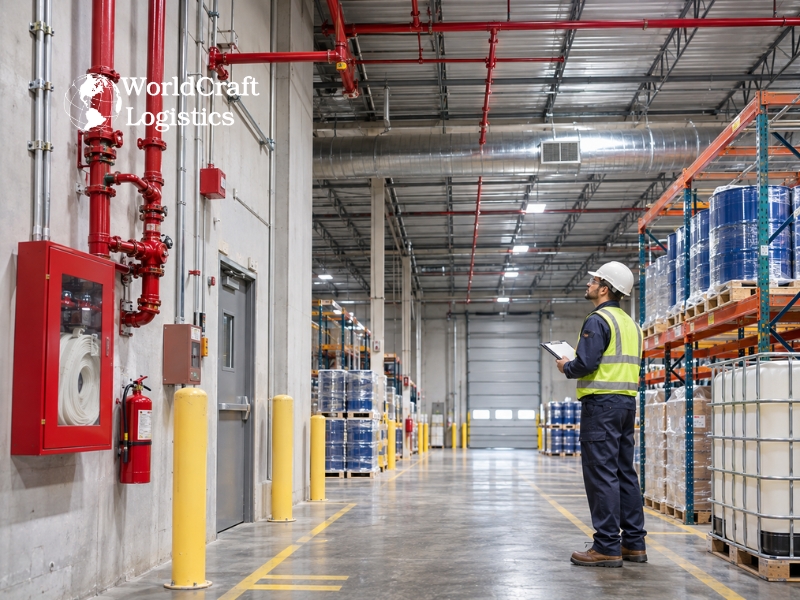
Chemical warehouse safety involves more than following general workplace procedures. Facilities must identify which federal, state, and local regulations apply to the chemicals they handle, the activities they perform, and the quantities they store. In the United States, several regulatory frameworks address workplace safety, hazardous waste, chemical inventory reporting, transportation, and fire protection.
OSHA's Hazard Communication Standard (29 CFR 1910.1200) requires employers to communicate chemical hazards to employees through labels, Safety Data Sheets (SDS), and appropriate training. For chemical warehouses, this includes maintaining accessible hazard information, ensuring containers are properly labeled, and training employees on the chemicals they may encounter during their work.
OSHA revised the HCS in May 2024 to align more closely with the seventh revision of the Globally Harmonized System (GHS). Following a January 2026 extension, the updated compliance deadlines include:
Responsible PartyUpdated DeadlineManufacturers, importers, and distributors – substancesMay 19, 2026Employers – substancesNovember 20, 2026Manufacturers, importers, and distributors – mixturesNovember 19, 2027Employers – mixturesMay 19, 2028
These deadlines distinguish between chemical suppliers and employers. Warehouse operators should review their hazard communication programs, workplace labels, SDS information, and employee training against the requirements applicable to their operations.
Under 29 CFR 1910.106, OSHA establishes requirements for handling and storing flammable liquids in workplaces. Depending on the storage arrangement and quantities involved, these requirements may address approved containers, inside storage rooms, ventilation, fire protection, and electrical equipment.
For warehouse operators, compliance involves evaluating the facility layout and storage practices against the specific provisions that apply to the products being handled. A general fire protection system alone does not establish compliance with every flammable liquid storage requirement.
The Environmental Protection Agency (EPA) oversees several programs relevant to chemical warehousing. Two important frameworks are the Resource Conservation and Recovery Act (RCRA) and the Emergency Planning and Community Right-to-Know Act (EPCRA).
RCRA: regulates hazardous waste management, including accumulation, treatment, storage, and disposal. Businesses must distinguish commercial chemical products held for use or distribution from materials that meet the regulatory definition of hazardous waste. If warehouse activities generate or manage hazardous waste, additional requirements may apply based on the facility's generator status and operational role. For example, federal accumulation limits generally allow Small Quantity Generators (SQGs) up to 180 days and Large Quantity Generators (LQGs) up to 90 days to accumulate hazardous waste under specified conditions. These are hazardous waste accumulation limits, not general storage limits for commercial chemical inventory.
EPCRA Sections 311 and 312: establish hazardous chemical inventory reporting requirements for facilities that meet applicable thresholds. Subject to exemptions and specific conditions, reporting thresholds generally include 500 pounds or the applicable Threshold Planning Quantity (TPQ), whichever is lower, for Extremely Hazardous Substances, and 10,000 pounds for other covered hazardous chemicals. Tier II inventory reports are generally due by March 1 each year.
The Department of Transportation (DOT), through the Pipeline and Hazardous Materials Safety Administration (PHMSA), regulates hazardous materials transportation under 49 CFR Parts 171–180.
These regulations address classification, packaging, marking, labeling, documentation, and transportation-related handling. Section 177.848 also establishes segregation requirements for specified hazardous materials during transportation-related storage and handling.
Warehouse operators involved in shipping or preparing hazardous materials for transportation must understand which requirements apply to their activities. DOT transportation classifications should not be treated as a complete substitute for warehouse storage compatibility assessments.
Fire protection requirements may also involve NFPA standards and the International Fire Code (IFC), depending on the codes adopted by the relevant state and local jurisdiction. NFPA 30 addresses flammable and combustible liquids, while NFPA 400 covers hazardous materials. Applicable provisions may affect storage arrangements, fire protection, and allowable quantities.
In California, facilities subject to the Hazardous Materials Business Plan (HMBP) program may need to maintain hazardous materials inventories, emergency response procedures, employee training, and facility site maps. CalEPA oversees the statewide program, while Certified Unified Program Agencies (CUPAs) administer and enforce requirements locally.
Because regulatory obligations vary by product, quantity, facility, and activity, chemical warehouse operators should verify applicable requirements with the relevant authorities before accepting or expanding chemical inventory.
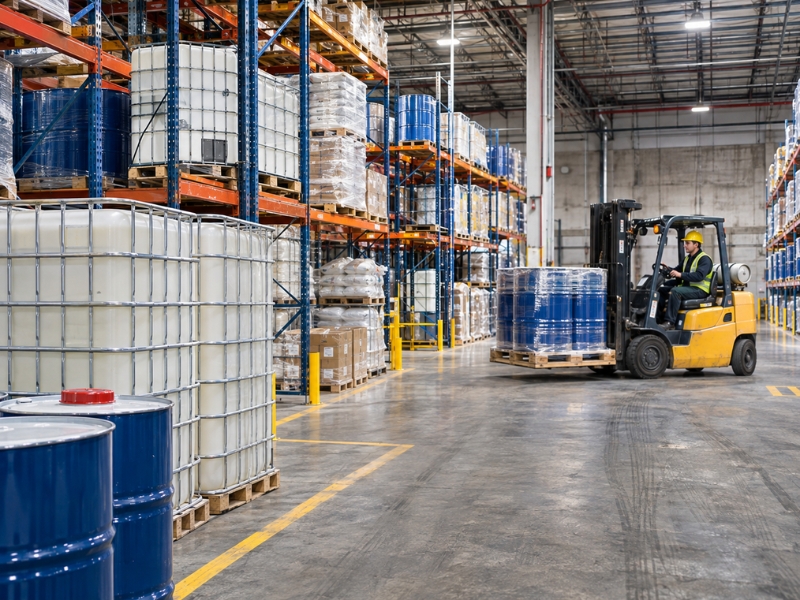
Effective chemical warehouse operations depend on accurate product information, controlled handling procedures, and reliable inventory records. From the moment a shipment arrives until its products are released for distribution, each movement should follow procedures that account for the chemical's characteristics and the facility's storage capabilities.
Receiving is the first opportunity to verify that incoming chemical products match the information provided before delivery. Warehouse personnel should check product identification, shipping documents, labels, packaging condition, and available Safety Data Sheets (SDS).
Inspections should also identify damaged containers, visible leaks, missing labels, or discrepancies between the shipment and receiving records. Products that do not meet the facility's acceptance requirements should be held in a designated area, where appropriate, pending further assessment. Suspected leaks or damaged hazardous materials require the facility's established emergency and incident response procedures rather than routine handling.
Chemical inventory management requires more than tracking product quantities. Warehouse operators need reliable records of product identity, storage location, lot or batch numbers, and inventory movements.
Important inventory practices include:
Lot and batch tracking: Maintain records that link products to their respective production or supply batches.
Inventory reconciliation: Compare recorded quantities with physical inventory to identify discrepancies.
Expiration and retest-date monitoring: Track relevant product dates and apply appropriate stock rotation procedures.
Location tracking: Maintain accurate records of where each product is stored within the facility.
Movement records: Document receiving, transfers, picking, and outbound transactions to support traceability.
FIFO or FEFO inventory methods may be used depending on product shelf life, customer requirements, and manufacturer recommendations.
A Warehouse Management System (WMS) helps coordinate inventory records and warehouse activities. In chemical warehousing, a suitably configured WMS can link product data with storage locations, lot information, handling instructions, and inventory movements.
Useful capabilities include barcode-based identification, location control, batch tracking, expiration alerts, SDS document access, and inventory reporting. These functions help warehouse teams locate products, maintain accurate records, and identify inventory that requires review.
However, a WMS does not automatically ensure chemical compatibility or regulatory compliance. Its effectiveness depends on accurate product data, appropriate system configuration, and procedures that warehouse personnel consistently follow.
Employees involved in chemical receiving, storage, and handling need training appropriate to their responsibilities and potential workplace exposures. Training may cover hazard communication, personal protective equipment (PPE), safe material handling, spill response, and emergency procedures.
Chemical warehouses should also maintain documented arrangements for responding to incidents such as container leaks, fires, or accidental releases. These procedures should identify reporting channels, isolation measures, emergency equipment, and coordination with appropriate response personnel.
Regular inspections, equipment checks, and reviews of operating procedures help identify gaps before they develop into larger operational problems.
Chemical warehousing can create operational challenges when product requirements, warehouse capabilities, and logistics plans are not aligned. For importers, manufacturers, and distributors, these issues can lead to shipment delays, additional costs, inventory disruptions, and increased safety risks.
The following challenges are worth addressing before chemical products arrive at a warehouse.
A warehouse may refuse a chemical shipment if the products fall outside its accepted inventory profile, storage capabilities, or operational requirements. This can happen when the shipper confirms a booking without providing complete product information.
How to avoid it: Confirm product acceptance before dispatch. Share the product name, classification, SDS, packaging type, quantity, and any special storage requirements with the warehouse provider. Obtain written confirmation that the facility can handle the specific products and shipment configuration.
Incomplete, outdated, or inconsistent product information can delay receiving and prevent warehouse personnel from making informed storage decisions. Differences between the SDS, shipping documents, and product labels may also require additional verification.
How to avoid it: Maintain current SDS documents and ensure product descriptions, hazard information, labels, and shipping records are consistent. Notify the warehouse provider when a product formulation, classification, or packaging specification changes.
A warehouse may have sufficient floor space but lack the designated areas, environmental controls, or separation capacity required for a particular chemical product. This becomes especially challenging when inventory volumes fluctuate or multiple product types arrive together.
How to avoid it: Discuss expected inventory volumes, product mix, packaging dimensions, storage duration, and peak-season requirements before selecting a facility. Evaluate available capacity based on the products' actual storage needs, not just total warehouse square footage.
Chemical warehousing costs may exceed initial estimates when shipments require additional inspections, special handling, dedicated storage areas, extended documentation review, or non-standard equipment. Unplanned storage time can further increase total logistics expenses.
How to avoid it: Request a detailed quotation that identifies standard and additional charges. Clarify how the provider bills receiving, storage, handling, inspections, special services, and after-hours work. Also confirm which circumstances may trigger additional fees.
Check out this article now: Optimizing Logistics Warehouse Costs
Without reliable inventory records, businesses may struggle to identify where chemical products are stored, reconcile stock movements, monitor lot numbers, or plan replenishment. Poor visibility can disrupt production schedules and make inventory reporting more difficult.
How to avoid it: Choose a provider that can supply timely inventory reports and traceability records. Confirm what information is available, how frequently it is updated, and whether customers can access inventory data through a warehouse management system or reporting process.
Addressing these challenges early helps businesses select a suitable chemical warehouse, plan more predictable chemical logistics, and reduce avoidable operational disruptions.
Choosing the right chemical warehousing 3PL requires more than comparing storage rates. Businesses should evaluate whether a provider can safely accommodate their specific products, maintain inventory visibility, and support their U.S. logistics operations.
Before selecting a chemical warehouse, consider these key factors:
Product acceptance: Confirm that the provider accepts your specific chemical products, classifications, packaging types, and inventory quantities. Never assume a facility can handle every chemical simply because it offers chemical storage.
Storage and safety capabilities: Review available storage conditions, product segregation procedures, handling equipment, employee training, and emergency response arrangements.
Regulatory requirements: Ask how the provider manages relevant SDS documentation, product information, inspections, and applicable warehouse safety requirements.
Inventory visibility: Look for reliable inventory reports, lot and batch tracking, storage location records, and accessible transaction history.
Service flexibility: Evaluate receiving, storage, order fulfillment, transloading, and distribution capabilities based on your supply chain requirements.
Pricing and insurance: Clarify storage rates, handling fees, additional service charges, insurance coverage, liability limits, and product-related exclusions.
For businesses seeking a reliable logistics partner in the United States, WorldCraft Logistics offers warehousing and logistics support designed to help manage inventory and streamline supply chain operations.
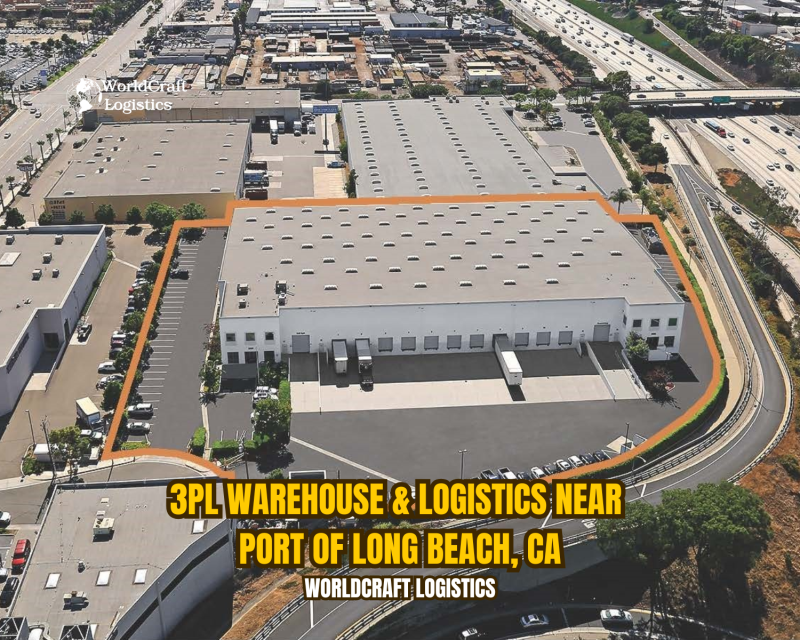
With warehouse locations in Ontario, Union City, and Cerritos, California, WorldCraft Logistics provides services including:
Warehousing: Storage solutions for suitable product categories.
Order Fulfillment: Inventory handling and order processing.
Transloading: Cargo transfers between transportation modes.
Distribution: Support for moving products through U.S. supply chains.
For chemical warehousing inquiries, WorldCraft Logistics evaluates products individually to determine whether they fall within its accepted storage capabilities. Businesses should provide product details, SDS documents, packaging specifications, and expected storage volumes for an initial assessment.
Looking for a dependable U.S. warehousing partner for your chemical products?
Contact WorldCraft Logistics to discuss your storage and logistics requirements. Our team can review your product information, assess potential warehouse suitability, and help identify the right solution for your supply chain.
WorldCraft Logistics | Dangerous Goods Warehousing
Ensure compliance and zero risk for your dangerous goods with WorldCraft Logistics' certified high-security warehousing. Secure your high-risk cargo with top-tier facilities and expert handling today!
Secure Your Hazardous Cargo Now →
*Fully compliant and certified dangerous goods storage solutions.
Effective chemical warehousing requires more than available storage space. Businesses must consider product hazards, storage compatibility, regulatory requirements, inventory control, and the warehouse provider's actual capabilities.
Choosing the right chemical warehousing partner can help reduce operational risks, improve inventory visibility, and maintain a more reliable supply chain.
If your business needs warehousing support in the United States, WorldCraft Logistics can help evaluate your storage and logistics requirements. Contact our team to discuss your products and determine whether our warehouse capabilities are a suitable fit.
1. Can a warehouse refuse a chemical shipment after it has been dispatched?
Yes. A warehouse may refuse or place a shipment on hold if the products do not match the approved inventory profile, documentation is incomplete, or the facility cannot safely accommodate the shipment. Confirm product acceptance before dispatch to reduce delays and additional transportation costs.
2. What happens if a chemical shipment arrives without an SDS?
The warehouse may delay receiving or place the shipment on hold until the necessary product safety information is obtained and reviewed. Requirements depend on the product, applicable regulations, and the warehouse's procedures. Shippers should provide current SDS documentation before arranging delivery.
3. Can a 3PL store chemicals without owning the products?
Yes. A third-party logistics provider (3PL) can store customer-owned inventory under a warehousing agreement. The agreement should clearly define storage responsibilities, handling procedures, documentation requirements, insurance, and liability between the parties.
4. Who is responsible for chemical safety: the shipper or the warehouse operator?
Responsibilities depend on the parties' roles, activities, and applicable regulations. Shippers are generally responsible for providing accurate product information and required shipping documentation, while warehouse operators must address safety obligations associated with their own operations. A contract should clearly define each party's responsibilities without assuming that one party takes over all legal obligations.
5. What information should I provide when requesting a chemical warehousing quote?
Prepare the following information:
Product names and descriptions
Current SDS documents
Hazard classifications, where applicable
Packaging types and dimensions
Expected inventory quantities
Estimated storage duration
Inbound and outbound shipment frequency
Any special storage or handling requirements
Providing these details helps the warehouse provider assess product suitability and prepare a more accurate quotation.
6. Does general warehouse insurance cover hazardous chemicals?
Not necessarily. Insurance policies may contain exclusions, restrictions, or specific conditions for hazardous materials and certain chemical products. Businesses should request written confirmation of coverage, applicable limits, deductibles, and exclusions for the products being stored.
7. What should I do if a chemical container leaks during storage?
A leaking container should be handled under the facility's established emergency and spill response procedures. Personnel should follow applicable training, isolate the affected area when appropriate, and use suitable response resources. The incident should be documented and reported according to applicable requirements and the warehouse's procedures.