05/27/2026
If you import goods from Asia or run a high-volume e-commerce operation in the Western United States, where you store your inventory is not just a logistics decision. It is a cost decision, a speed decision, and increasingly a competitive advantage. Warehousing in Ontario, CA has emerged as one of the most strategic choices available in Southern California, and the reasons go well beyond simply being close to the ports.
The Inland Empire region, anchored by Ontario, Rancho Cucamonga, Chino, and Fontana, now holds one of the largest concentrations of industrial warehouse space in the entire country. For importers dealing with congested terminals, rising demurrage fees, and the constant pressure to ship faster, Ontario offers a compelling combination of port proximity, freeway access, lower real estate costs, and a mature logistics infrastructure that few locations in California can match.
This guide breaks down exactly why Ontario, CA has become a preferred warehousing hub for importers and e-commerce brands, what to look for when choosing a facility, and how to determine whether this market is the right fit for your supply chain.
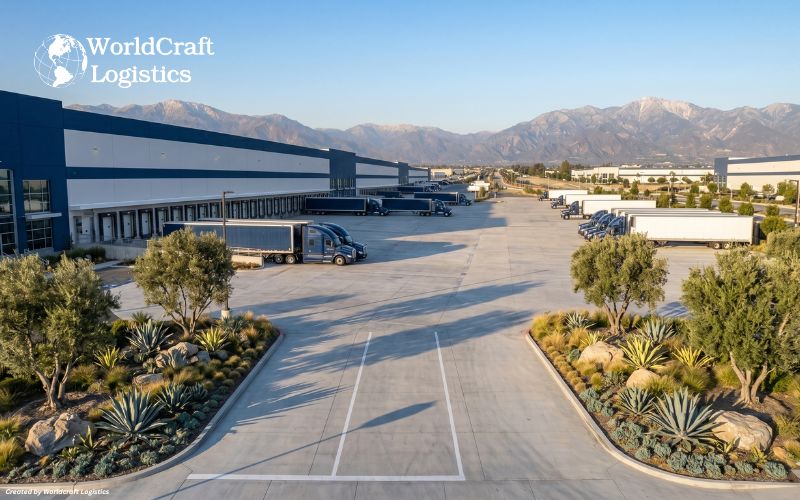
A decade ago, most importers defaulted to leasing space in Los Angeles, Carson, or near the ports of San Pedro and Long Beach. That calculation has shifted dramatically. As industrial land in the LA Basin became scarce and lease rates climbed well above $1.50 per square foot NNN, businesses began moving their warehousing operations eastward along the I-10 corridor.
Today, the Inland Empire industrial market spans more than 700 million square feet of industrial space, making it one of the top three industrial markets in the United States. Ontario sits at the heart of this corridor, offering modern distribution facilities, Class A warehouse stock, and direct freeway access to every major population center in the Western US. Vacancy rates in the submarket have stabilized in the 5 to 7 percent range as of 2024 to 2025, reflecting strong ongoing demand while still providing availability for growing businesses.
The shift is not just about cost. It is about infrastructure maturity. Ontario International Airport (ONT) handles significant air cargo volume. The BNSF and Union Pacific intermodal facilities in San Bernardino County enable efficient rail-to-truck transfers. And the city of Ontario itself has invested heavily in roadway infrastructure supporting heavy commercial truck traffic, a detail that matters enormously when your operation runs dozens of container moves per week.
Ontario, CA is a top choice for Inland Empire warehousing because it sits approximately 55 to 60 miles from both the Port of Los Angeles and the Port of Long Beach, offers direct access to the I-10, I-15, and SR-60 freeways, and provides warehouse lease rates that run 20 to 35 percent below comparable facilities in the LA Basin. For businesses that import by container or ship e-commerce orders to Western US customers, this combination of proximity, access, and cost is difficult to replicate elsewhere in California.
The Port of Los Angeles and the Port of Long Beach together form the busiest port complex in the Western Hemisphere, handling roughly 40 percent of all US containerized imports. Ontario is approximately 55 to 60 miles from both terminals, close enough to keep drayage costs manageable, far enough to escape the land costs and congestion of the immediate port zone.
When containers arrive at the port, importers typically have a narrow window of free time, usually two to five days, before demurrage fees begin accruing. In periods of port congestion, those fees can reach $150 to $350 per container per day and climb higher for extended delays. Moving cargo quickly to an Ontario, CA warehouse eliminates this exposure. Drayage from the LA and Long Beach terminals to the Inland Empire typically runs $450 to $850 per container, depending on weight, chassis availability, and specific origin terminal a one-time cost that is almost always far cheaper than allowing containers to sit at the port.
For importers who move high volumes, this math adds up fast. A business receiving 50 containers per month that avoids even two days of demurrage per container saves tens of thousands of dollars annually by maintaining a reliable inland warehouse like those available in Ontario.
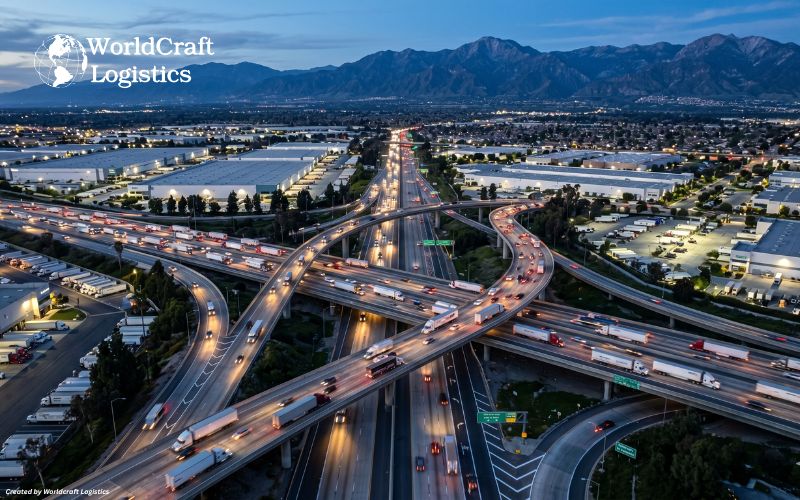
Ontario sits at one of the most advantageous highway intersections in Southern California. The I-10 freeway runs east toward Phoenix, Tucson, and eventually El Paso, while heading west, it connects directly into the LA Basin and toward the port terminals. The I-15 freeway runs north toward Las Vegas and Salt Lake City, and south toward San Diego and the US-Mexico border. The SR-60 provides an additional westbound corridor into the San Gabriel Valley and greater Los Angeles.
This freeway convergence translates directly into delivery speed. From a warehouse in Ontario, CA, a truck can reach:
Port of Los Angeles or Long Beach in approximately 60 to 75 minutes under normal traffic conditions
Las Vegas, Nevada in approximately 2.5 to 3 hours
Phoenix, Arizona in approximately 5 to 5.5 hours
San Diego, California in approximately 1.5 to 2 hours
San Francisco Bay Area in approximately 5.5 to 6.5 hours
Reno, Nevada in approximately 7 to 8 hours
For ground shipping, this means that a significant majority of Western US consumers can receive their orders within two business days from an Ontario distribution point. Major parcel carriers, including UPS, FedEx, and USPS, all have established operations in or near Ontario, and 2-day ground coverage from Ontario, CA reaches over 95 percent of the Western US population, including the entirety of California, Nevada, Arizona, and most of Utah.
One of the strongest financial arguments for warehousing in Ontario, California is the lease rate differential versus the LA Basin. While rates fluctuate with market conditions, the pattern has remained consistent: Ontario and the broader Inland Empire consistently price at a meaningful discount to Los Angeles, Carson, and the South Bay.
| Market | Avg. NNN Lease Rate (2024–2025) | Vacancy Rate | Avg. Clear Height |
|---|---|---|---|
| Ontario / Inland Empire West | $0.85 – $1.15 / sqft | 5% – 7% | 32 – 40 ft |
| Los Angeles Basin (South Bay) | $1.35 – $1.80 / sqft | 3% – 5% | 28 – 36 ft |
| Long Beach / Carson | $1.40 – $1.90 / sqft | 3% – 4% | 28 – 36 ft |
| San Bernardino / Fontana | $0.78 – $1.05 / sqft | 6% – 9% | 32 – 40 ft |
Beyond the rate difference, Ontario's industrial infrastructure is modern. A large share of the available inventory was built in the last 15 years, meaning higher clear heights (32 to 40 feet), ESFR sprinkler systems, and dock-door ratios that support high-velocity operations. Businesses that outgrow their existing space also have more options for expansion in the Inland Empire than in most coastal LA submarkets.
The Inland Empire is home to a large and established logistics workforce. San Bernardino and Riverside counties together employ hundreds of thousands of workers in transportation, warehousing, and distribution roles, a labor pool that has grown alongside the region's warehouse footprint over the past two decades.
Major global logistics operators, including Amazon, Walmart, Home Depot, IKEA, and numerous 3PL providers, have built or leased large facilities in the Ontario and broader Inland Empire area precisely because the workforce is available, experienced, and accustomed to the operational demands of high-volume warehousing. For a growing brand looking to plug into an established ecosystem rather than build from scratch, this matters considerably.
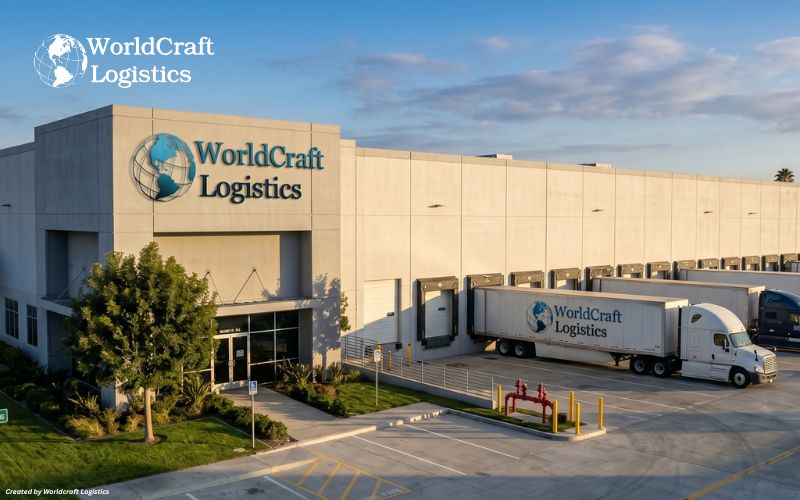
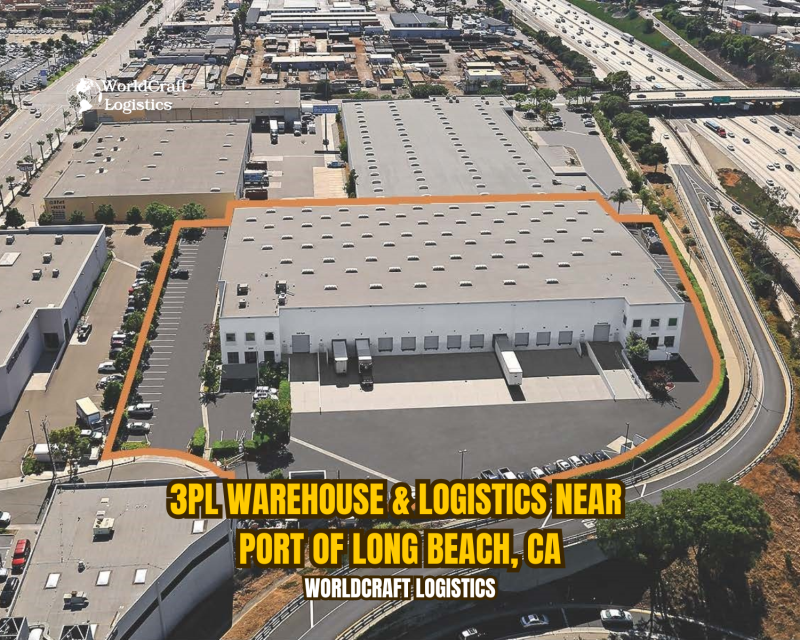
Among the 3PL warehouse operators in Ontario, CA, Worldcraft Logistics stands out for its focus on the specific operational needs of importers and e-commerce brands bringing goods in from Asia. Their Ontario facility is an FDA-registered, high-bay warehouse positioned in the Inland Empire's most accessible industrial corridor, with direct connectivity to the I-10 and I-15 interchange.
The operation is built around the full import-to-fulfillment workflow: container unloading, inventory receiving and inspection, SKU-level storage, pick-and-pack fulfillment for both B2B and B2C channels, cross-docking and transloading, and dedicated FBA prep services. The team works with importers who handle everything from food and health supplements to consumer electronics, beauty products, and seasonal retail goods.
What distinguishes their Ontario operation from generic storage providers is the depth of experience with inbound container logistics. Coordinating drayage, managing customs-released cargo, handling mixed-SKU container loads, and building outbound pallets to retailer routing guide specifications are core competencies not add-on services. For businesses scaling their US import and distribution operations, that operational depth is significant.
Learn more about Worldcraft Logistics' Ontario, CA warehouse facility, specifications, and pricing.
Not every business needs to be in Ontario. But for certain types of operations, the case is unusually strong. Here is where the location genuinely outperforms the alternatives.
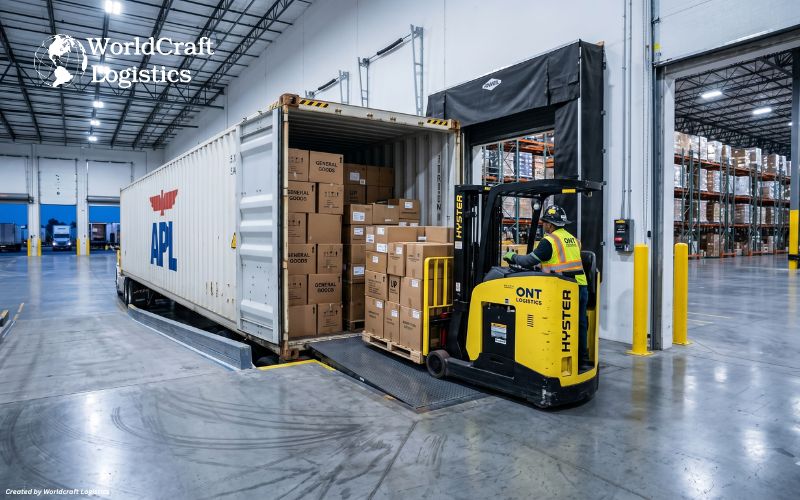
For businesses receiving ocean freight containers through the San Pedro Bay port complex, an import warehouse in Southern California near Ontario makes logistical and financial sense. The typical flow works as follows: containers are discharged at the terminal, picked up by a drayage carrier under port cartage, and moved to the Ontario warehouse, where they are unloaded, sorted, and prepared for outbound distribution.
The alternative, leaving containers at the port until they are needed, exposes importers to demurrage risk, terminal congestion, and the unpredictability of port operations. Having a dedicated inland warehouse in Ontario decouples your receiving operation from port variability. Cargo arrives at your facility on a predictable schedule, gets processed under controlled conditions, and is ready to ship to customers or retail partners within your own defined timeframe.
For importers handling seasonal peaks, the value compounds. Having a buffer stock already positioned in an Ontario warehouse before your busy season begins means you are not dependent on port throughput speed during the months when congestion is highest.
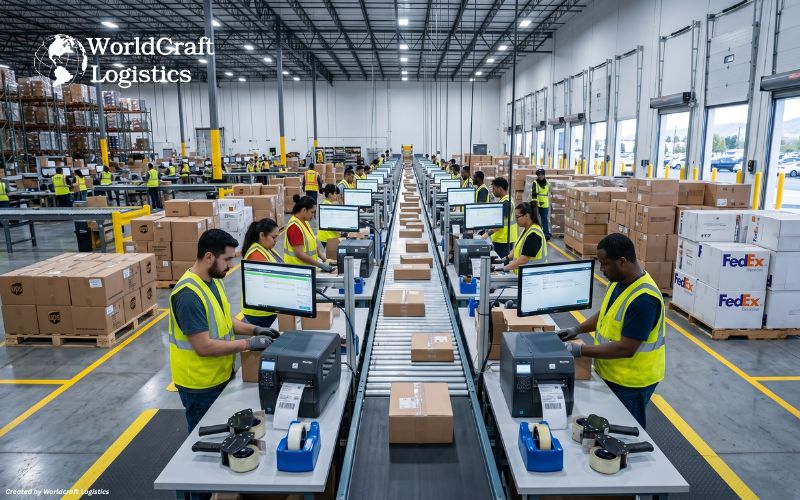
Consumer expectations have fundamentally changed. Two-day delivery is no longer a premium offering; it is a baseline expectation for most categories of e-commerce. An e-commerce fulfillment center in Ontario, CA gives brands one of the best ground shipping footprints available in the western United States without the cost of operating a multi-node network.
From a single Ontario warehouse, ground parcel shipments reach all of California, Nevada, Arizona, Utah, and significant portions of Oregon, Idaho, and New Mexico within two days using standard UPS Ground or FedEx Home Delivery services. For brands that are heavily concentrated in California, which represents the largest single-state e-commerce market in the US, this single-node strategy is remarkably efficient.
Compared to fulfillment from a Nevada location, Ontario offers faster delivery to the Southern California population corridor (LA, San Diego, the Inland Empire itself), which is where a large share of Western US e-commerce volume originates. Compared to fulfilling from within Los Angeles, Ontario offers lower warehouse costs while maintaining nearly identical delivery time coverage.
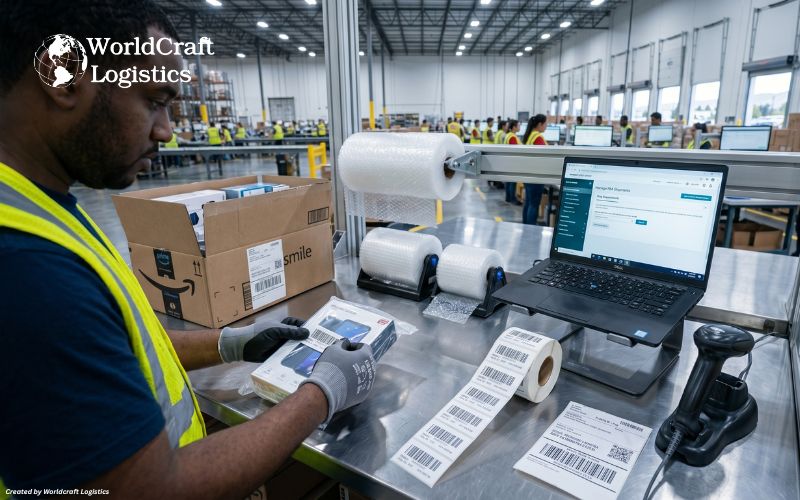
The Ontario and Inland Empire area has multiple Amazon fulfillment centers within a short drive, including facilities in Ontario, Moreno Valley, Fontana, and Redlands. For sellers using Fulfillment by Amazon (FBA), having a prep center nearby dramatically reduces the time and cost of getting inventory into the Amazon network.
A dedicated FBA prep center in Ontario, CA handles the specific requirements Amazon imposes on inbound shipments: FNSKU labeling, poly bagging, bubble wrapping fragile items, building mixed pallets to Amazon's specifications, and creating shipment plans. Sellers who do this work at a local 3PL before sending to Amazon avoid the expense of Amazon's own prep services, maintain better control over compliance, and reduce the risk of receiving violations.
For sellers importing directly from Asia, the workflow becomes especially efficient. Containers arrive at the Ontario warehouse from the port, are unloaded and inspected, prepped to FBA standards, and sent directly to the nearest Amazon fulfillment center, often on the same day or the next.
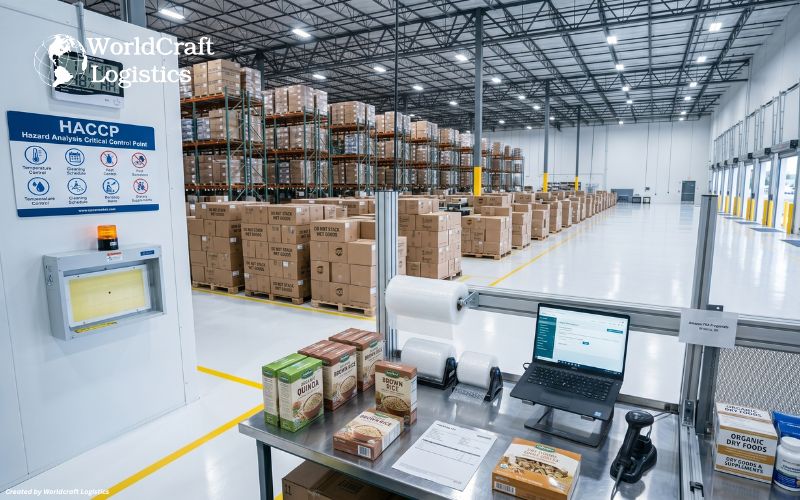
Businesses importing or distributing food products, dietary supplements, cosmetics, over-the-counter health products, or certain medical devices are required by federal law to store inventory in facilities registered with the US Food and Drug Administration. FDA-registered warehouses in Southern California are a requirement, not an option, for this category of importer.
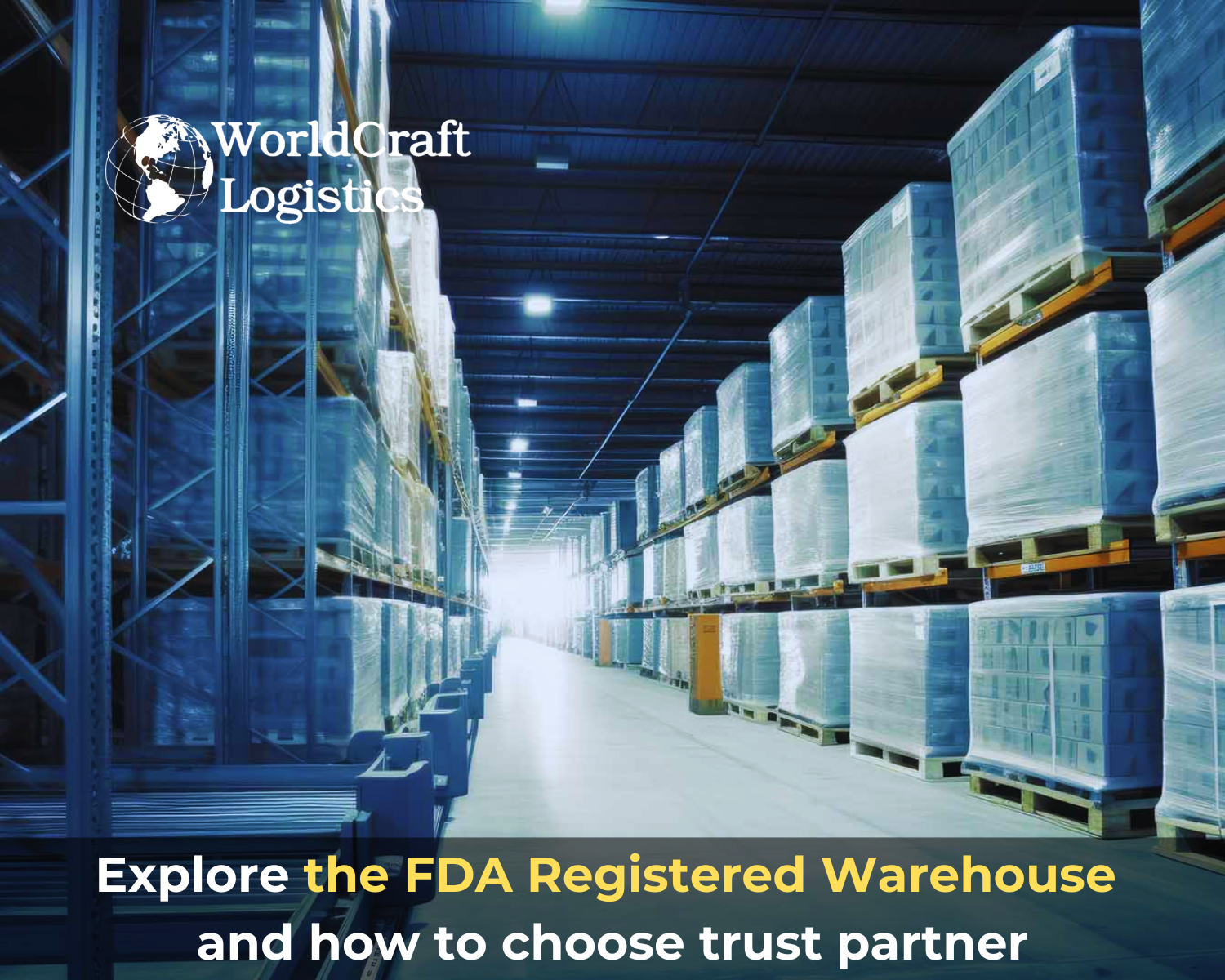
FDA warehouse registration is free and available to any qualifying facility through the FDA's online portal. The registration requires the facility to meet Good Manufacturing Practice (GMP) standards for sanitation, pest control, temperature documentation, and product traceability. Not all warehouses in the Inland Empire hold FDA registration, making this a key qualification to verify when evaluating storage options for regulated product categories.
Ontario and the broader Inland Empire have a meaningful number of FDA-registered facilities, particularly those serving the food, beauty, and health supplement import sectors categories where California, and Southern California specifically, represents a major distribution hub given the state's large Asian-American and health-conscious consumer base.
Knowing that Ontario is a strong market is the starting point. The harder question is how to evaluate specific facilities. These are the factors that experienced logistics buyers look at carefully.
The Inland Empire is a large geography. While Ontario is the most centrally positioned city in the west, IE, a facility in Fontana, Chino, Rancho Cucamonga, or even Rialto can vary significantly in terms of port distance, highway access, and truck traffic patterns.
| City | Approx. Distance to Ports | Key Highway | Best For |
|---|---|---|---|
| Ontario | 55 – 60 miles | I-10, I-15, SR-60 | Importers, FBA prep, general 3PL operations |
| Chino / Chino Hills | 50 – 55 miles | SR-60, SR-71 | E-commerce and consumer goods fulfillment |
| Fontana / Rialto | 65 – 75 miles | I-10, I-15 | High-volume logistics and large-format warehouse storage |
| Rancho Cucamonga | 60 – 65 miles | I-10, I-15 | Mixed-use logistics and retail distribution |
For most importers, Ontario proper offers the best balance of port proximity and freeway convergence. The I-10 and I-15 intersection is accessible from virtually anywhere in the Ontario industrial corridor without navigating surface street congestion, which becomes meaningful when you are coordinating multiple container pickups per day.
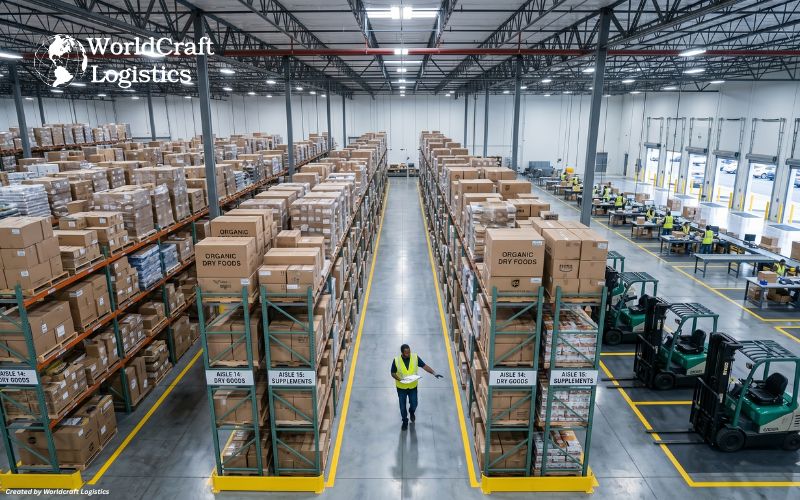
There is a significant difference between a warehouse that provides space and a 3PL in Ontario, California that provides operational services. For most importers and e-commerce brands, the latter is far more valuable. Here is what to evaluate when reviewing a potential partner's service capabilities:
Receiving and unloading: Does the facility handle full container unloads, or do you need to arrange your own labor?
Inventory management system: Real-time WMS access, SKU-level tracking, and reporting capabilities are non-negotiable for e-commerce operations.
Pick, pack and ship: B2B pallet builds for retail partners and B2C individual order fulfillment are distinct operations; confirm the facility handles both if needed.
Cross-docking and transloading: The ability to unload from ocean containers directly into domestic trailers without storing inventory is a significant cost advantage for high-velocity importers.
FBA prep services: FNSKU labeling, poly bagging, carton preparation, and Amazon-compliant pallet builds require specific knowledge and quality control processes.
Returns processing: For e-commerce brands, the ability to receive, inspect, and restock or dispose of customer returns is increasingly important.
Before signing any warehousing agreement in Ontario or the broader Inland Empire, verify the following certifications and compliance factors:
FDA Registration: Required if you store food, supplements, cosmetics, or OTC health products. Ask for the FDA registration number and verify it on the FDA's public database.
Fire safety and sprinkler systems: California fire code requires ESFR (Early Suppression Fast Response) sprinkler systems in high-bay warehouses. Verify the system type and last inspection date.
Insurance and liability: Any reputable 3PL carries cargo liability insurance. Request a certificate of insurance and understand coverage limits per occurrence.
Security systems: 24-hour video surveillance, controlled access, and alarm monitoring are standard in Class A facilities. This matters for high-value cargo and insurance premium calculations.
Hazmat compliance: If any of your products contain lithium batteries, aerosols, or other regulated materials, the facility needs specific hazmat storage compliance.

SEO
Digital Marketing/SEO Specialist
Simon Mang is the SEO and Digital Marketing Specialist at Worldcraft Logistics, where he leads content strategy to promote the company's online presence. With years of experience in digital marketing and a strong understanding of the logistics industry, he has published more than 500 specialized articles across freight, warehousing, and supply chain topics. ( Reviewed for accuracy by the Worldcraft Logistics Operations Team ).