02/25/2026
Importing machinery to the USA offers significant opportunities for construction firms, manufacturers, and procurement managers to access specialized equipment or leverage cost advantages in global markets. However, the process is far more complex than standard retail logistics. It involves a rigorous intersection of Customs and Border Protection (CBP) protocols, Environmental Protection Agency (EPA) emissions standards, and Department of Transportation (DOT) safety regulations.
For the unprepared importer, the risks are substantial. A missing EPA label or an incorrect Harmonized System (HS) code can result in indefinite port delays, expensive storage fees (demurrage), or the seizure and forced re-export of valuable assets. This guide provides a professional, step-by-step breakdown of the regulatory requirements, duty calculations, and logistics strategies necessary to successfully import heavy equipment into the United States.
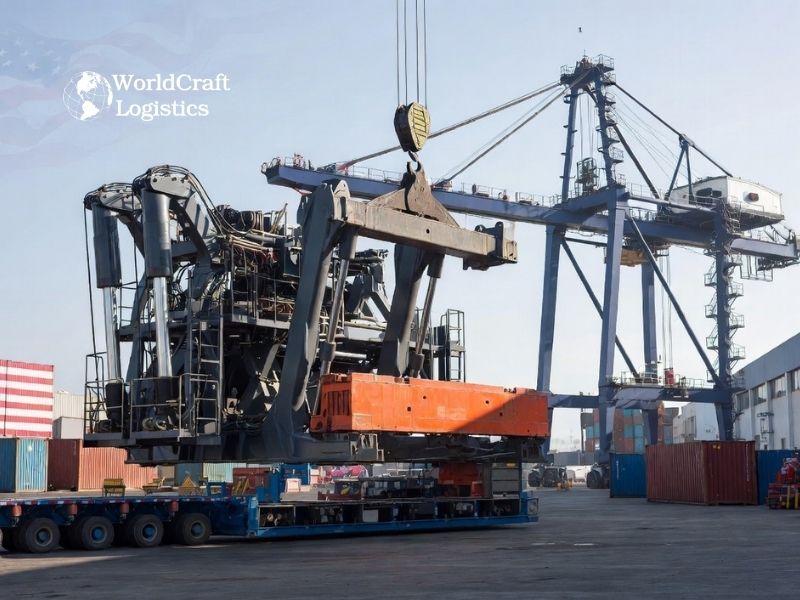
Importing machinery into the US is the process of bringing industrial equipment, construction vehicles, or manufacturing hardware from a foreign origin into the United States. This process requires filing specific entry documentation with U.S. Customs and Border Protection (CBP) and proving compliance with Partner Government Agencies (PGAs), specifically the EPA and USDA.
Unlike general merchandise, machinery imports are heavily scrutinized for two primary reasons: environmental standards and biosecurity. The EPA regulates engine emissions under the Clean Air Act, requiring strict documentation for diesel and gasoline engines. Simultaneously, the USDA monitors equipment for foreign soil contaminants that could introduce pests to American agriculture. Successful importation requires navigating Entry Type 01 (Consumption Entry), securing a Customs Bond, and ensuring the physical cleanliness of the cargo before it ever leaves the port of origin.
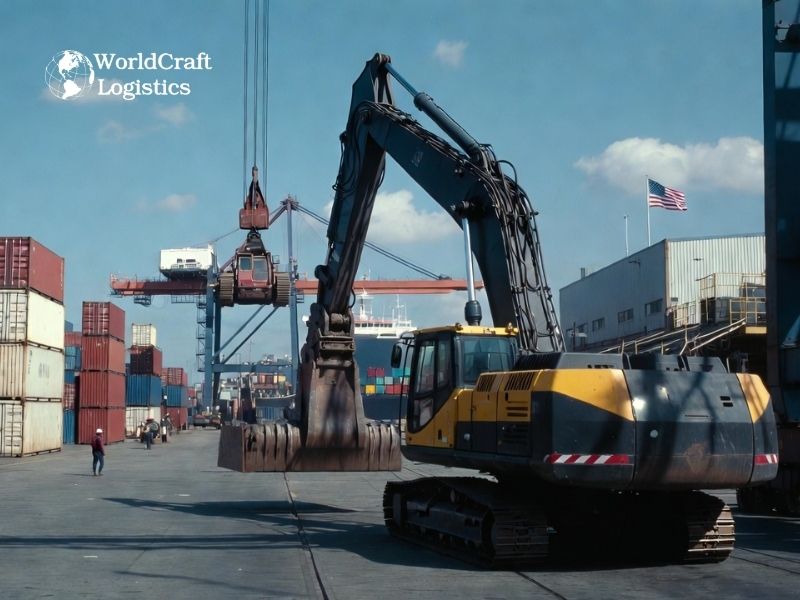
Importing machinery often involves oversized cargo, steel components, and industrial parts. If your shipment includes structural materials or fabricated components, you may also want to review our detailed guide on How to Import Steel & Metal into the USA to ensure full compliance with U.S. trade regulations. |
The foundation of a smooth entry lies in the paperwork. When CBP officers review your shipment, they are not looking at the machine immediately; they are looking at the data. Inconsistencies here are the leading cause of customs exams.
This is the primary document used for valuation and classification. For machinery, a standard invoice is insufficient. It must include the specific breakdown of the equipment, including the make, model, year of manufacture, and most importantly, the serial numbers (VIN or PIN) for every unit. If you are importing an excavator with a detached bucket, list the bucket separately on the invoice to avoid confusion during inspection.
This document details how the freight is physically arranged. If you are shipping heavy equipment overseas via container, the packing list must match the physical count exactly. For RoRo (Roll-on/Roll-off) shipments, this document verifies the dimensions and weight, which determines handling fees at the port.
The BOL acts as the title to the goods. For ocean freight, this is your Master Bill of Lading (MBL) or House Bill of Lading (HBL). The consignee details on the BOL must match your Importer of Record (IOR) registration exactly.
Sent by the freight forwarder or carrier, this document alerts you that the vessel is approaching the US port. This triggers the window for your customs broker to file the entry.
Importer Risk Scenario: An importer buys a used bulldozer from Japan. The invoice lists the total price but fails to itemize the serial number. CBP places a hold on the shipment to verify the machine isn't stolen or subject to sanctions. The correction takes three days. In that time, the free time at the port expires, and the importer incurs $900 in storage fees.
Mitigation: Ensure your supplier explicitly lists all serial numbers on the Commercial Invoice before the cargo departs.
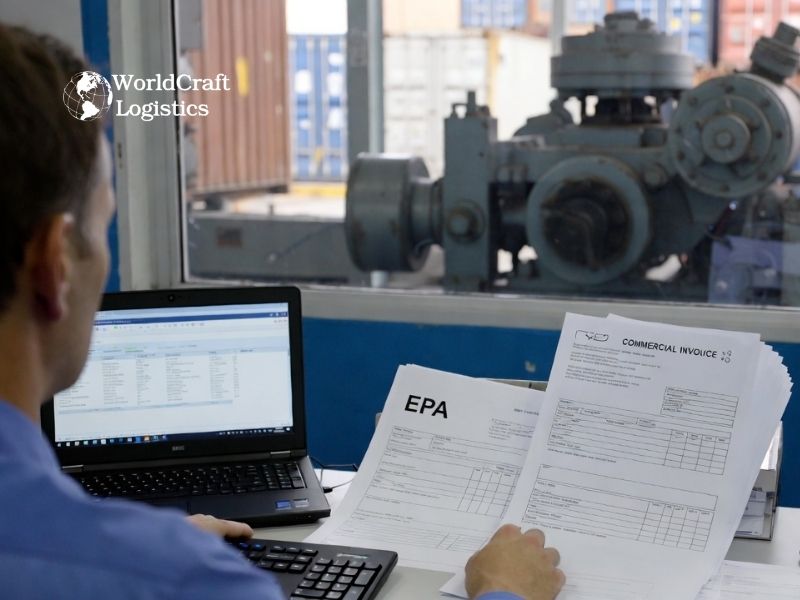
Our team at Worldcraft Logistics specializes in heavy equipment transport, customs clearance, ISF filing, and compliance management. Speak with our import specialists today to get a tailored shipping solution for your machinery project. >>> REQUEST AN OVERSIZE CARGO QUOTE <<< |
The most technical hurdle in importing construction machinery to the USA is environmental compliance. The United States has some of the strictest emission standards in the world (Tier 4 Final).
EPA Form 3520-21 is the declaration form for the importation of non-road and heavy-duty highway engines. This includes excavators, forklifts, generators, and tractors. By signing this form, you legally declare that the engine meets US emission standards.
Every piece of regulated machinery must have an original, manufacturer-installed EPA emission control label. This label serves as proof that the engine was built to conform to US regulations. If this label is missing or illegible, the machinery cannot be imported. There are no exceptions for "good condition" engines.
There are specific scenarios where non-conforming engines can enter:
The 21-Year Exemption: Generally, if the equipment is at least 21 years old and unmodified, it may be exempt from current EPA emission requirements. You must still file Form 3520-21 and check the appropriate exemption box.
Identical Configuration: If an engine was not built for the US market but is identical in all material respects to a US-certified configuration, you may be able to import it using a letter from the manufacturer confirming this status.
Risk Mitigation: Never assume a foreign engine meets US standards, even if it is a major brand like Caterpillar or Komatsu. European or Asian models often have different emission systems (e.g., Euro Stage V) that do not automatically reciprocate with US EPA Tier 4. Always verify the EPA label photo before purchase.
Determining the import duty on machinery in the USA requires identifying the correct Harmonized Tariff Schedule (HTS) code. Machinery generally falls under Chapter 84 of the HTS.
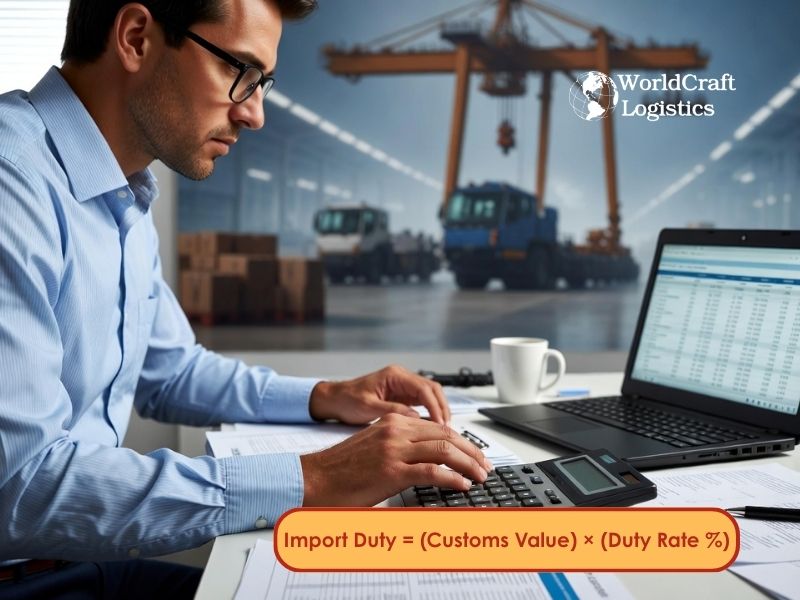
Duty is an ad valorem tax, meaning it is a percentage of the commercial value of the goods (excluding shipping and insurance costs).
Import Duty = (Customs Value) × (Duty Rate %)
In addition to the duty rate, importers must pay two mandatory fees:
Merchandise Processing Fee (MPF): For formal entries (value over $2,500), this is an ad valorem rate (approx 0.3464%) with a minimum of roughly $31 and a maximum of roughly $614 per entry.
Harbor Maintenance Fee (HMF): If arriving via ocean freight at a US port, this fee is 0.125% of the cargo value.
Large machinery often requires specialized handling similar to oversized liquid storage units. If you are planning to move industrial tanks or similar structures, explore our step-by-step guide on How to Transport a Water Tank Safely. |
The duty rate varies significantly based on the machine's function:
Agricultural Tractors: Often duty-free.
Excavators (360-degree revolving): Generally duty-free under specific subheadings.
Parts and Attachments: Often carry higher duty rates (2.5% to 5%) than the whole machine.
Note on Trade Wars: Be keenly aware of Section 301 tariffs. Machinery of Chinese origin may be subject to an additional 25% retaliatory tariff on top of the standard duty rate. This can turn a profitable import deal into a financial loss instantly. Always check the Country of Origin and current exclusions.
The logistics of importing heavy equipment to the USA dictate your costs and risk profile. You generally have three options for ocean transport.
This is the standard for drivable machinery. The unit is driven onto the vessel and secured to the deck. It is cost-effective and reduces handling damage. However, you cannot ship loose parts inside the cab. Everything must be empty.
For static machinery or equipment too wide for a standard container, a Flat Rack is used. The equipment is loaded onto a container base with open sides. This allows for OOG (Out of Gauge) cargo but exposes the machine to saltwater and elements. Shrink-wrapping is highly recommended.
Smaller machinery (skid steers, mini excavators) can be loaded into standard 40ft High Cube containers. This offers the best protection and lowest cost but requires professional blocking and bracing. If the machine shifts during transit, it can damage the container walls, leading to massive fines from the steamship line.
If your shipment also includes commercial furniture, fixtures, or assembled equipment, you may find our detailed breakdown helpful: How to Ship Furniture: Costs, Packaging & Best Options. |
For ocean shipments, the Importer Security Filing (ISF) must be transmitted to CBP at least 24 hours before the cargo is loaded onto the vessel at the foreign port. Failure to file on time results in a minimum $5,000 penalty.
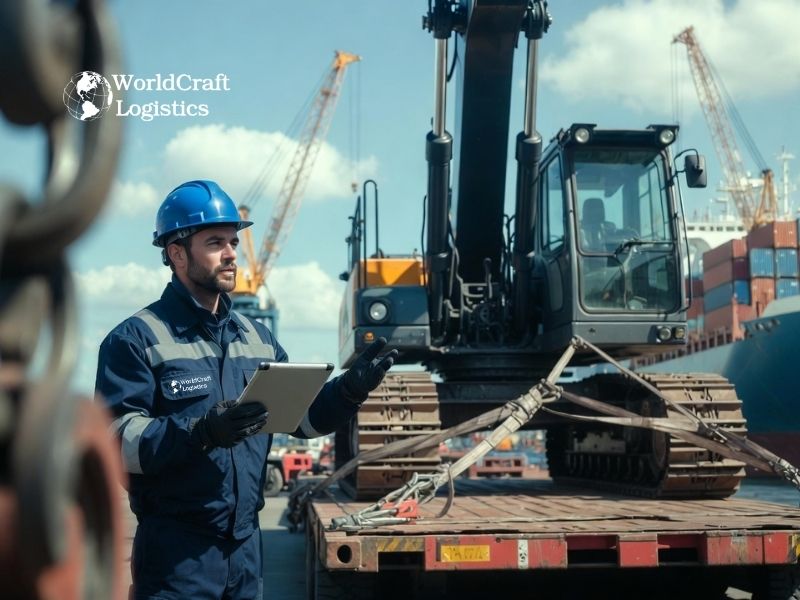
When importing construction machinery, the physical condition of the unit is as important as the paperwork.
The US Department of Agriculture (USDA) aggressively inspects imported machinery for foreign soil, seeds, and insects.
The Risk: If a CBP agriculture specialist finds a clump of dried mud in the wheel well or undercarriage, they will fail the shipment.
The Consequence: You cannot clean it at the US port. The container will be ordered for immediate re-exportation or destruction.
The Solution: Steam clean/pressure wash the equipment thoroughly before export. Pay for a pre-shipment survey to confirm cleanliness.
Demurrage is a storage fee charged by the shipping line or port terminal when your container sits too long.
Free Time: You typically get 4-5 days of free time to pick up your cargo after it arrives.
The Trap: If Customs pulls your container for an intensive exam (moving it to a Centralized Examination Station), this process can take 7-10 days. Your free time runs out, and you are charged daily fees ($150-$300+ per day) even though you cannot access your cargo.
Always budget a contingency fund of roughly 10% of the freight cost to cover potential exams and storage fees. It is better to have it and not need it than to have your cash flow frozen by a port hold.
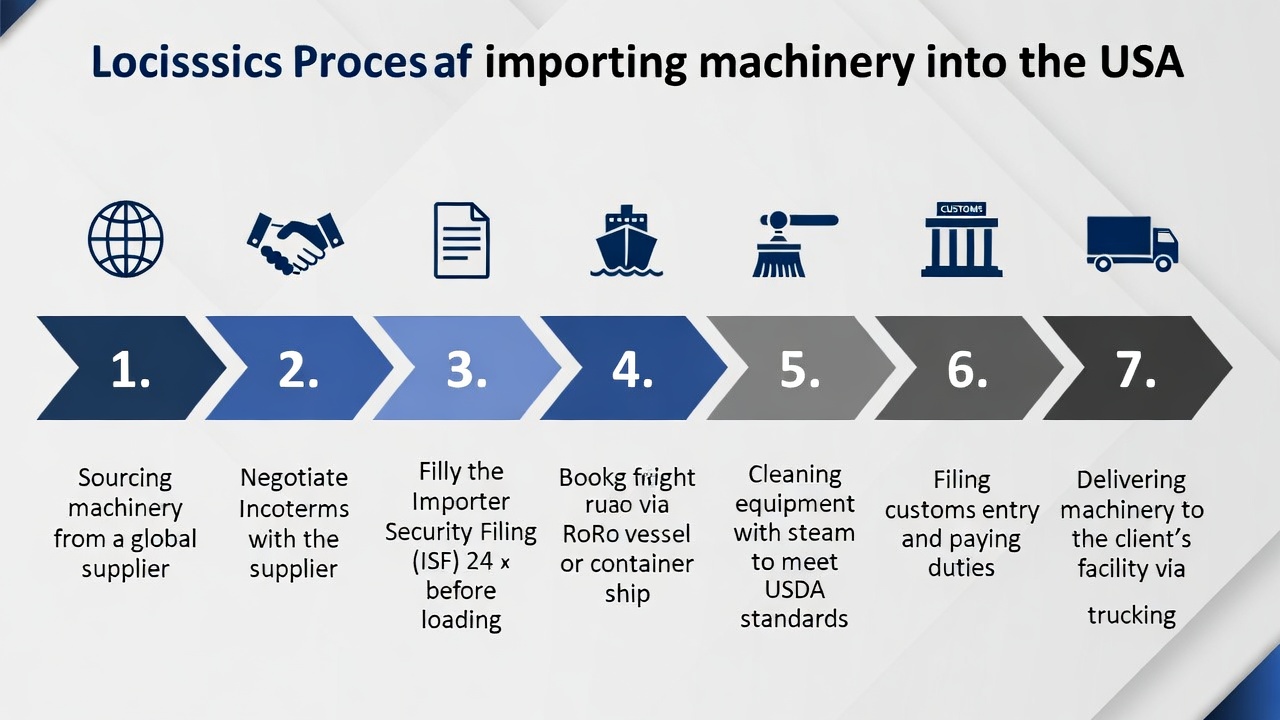
To summarize the process into an actionable workflow for procurement teams:
Sourcing & Vetting: Confirm the machine has an intact EPA label and verify the manufacturing year.
Incoterms Negotiation: Determine if you or the seller pays for export clearance (EXW vs. FOB vs. CIF).
ISF Data Collection: Gather shipper and consignee data for the 10+2 filing before the goods move.
Booking Freight: Select RoRo or Container based on size and budget.
Cleaning: Execute a rigorous steam clean of the undercarriage and tracks.
Departure & ISF Filing: File ISF 24 hours before loading.
Pre-Arrival Entry: Your broker files the Customs Entry (CBP Form 3461/7501) and EPA Form 3520-21 5 days before arrival.
Arrival & Payment: Pay duties to CBP and freight charges to the carrier.
Release & Delivery: Arrange trucking (drayage) to haul the equipment from the port to your facility.
Importing machinery into the United States requires technical expertise, regulatory knowledge, and precise logistics coordination.
Yes. Almost all heavy machinery with a diesel engine requires compliance with EPA regulations. You must file EPA Form 3520-21 at the time of entry. If the engine does not have a permanent manufacturer's EPA label, it generally cannot be imported unless it meets specific exemption criteria (like being over 21 years old).
Most construction machinery, such as hydraulic excavators and wheel loaders, enter the US duty-free or at a very low rate (e.g., free to 2.5%). However, you must still pay the Merchandise Processing Fee (MPF) and Harbor Maintenance Fee (HMF). Beware of the 25% Section 301 tariff if the equipment originates from China.
The mandatory documents include the Commercial Invoice (with serial numbers), Packing List, Bill of Lading, Arrival Notice, and EPA Form 3520-21. If the machine is for road use, you will also need DOT Form HS-7.
Yes. CBP can seize equipment if it is undeclared, significantly undervalued, contains prohibited soil/pests (USDA violation), or violates EPA emission standards. Seizures often result in the total loss of the asset plus legal penalties.
If all documents are correct and the ISF was filed on time, clearance can happen automatically within 24-48 hours of the vessel's arrival. However, if the cargo is flagged for an X-ray or intensive physical exam, the process can take 1 to 3 weeks.
While it is legally possible to self-file, it is highly discouraged for machinery due to the complexity of EPA and HS classifications. A licensed customs broker ensures the correct bond is posted and prevents costly filing errors.
ISF (Importer Security Filing) is a mandatory dataset submitted to CBP 24 hours before the cargo is loaded on a vessel destined for the US. It applies to ocean freight only. Missing this deadline results in a $5,000 fine.
Generally, no. Unless the engine qualifies for the 21-year exemption, the hardship exemption, or the replacement engine exemption, it must meet current Tier 4 Final emission standards to be legally imported into the US.
Oversized excavators are shipped via "RoRo" (Roll-on/Roll-off) vessels, where they are driven onto the ship, or via "Flat Rack" containers, where they are strapped to an open platform. RoRo is typically safer and more cost-effective for drivable units.
The USDA has a zero-tolerance policy for foreign soil. If dirt is found during inspection, the equipment will be denied entry. You will be forced to re-export the machine to its origin or another country, incurring massive freight and storage costs.

SEO
Digital Marketing/SEO Specialist
Simon Mang is the SEO and Digital Marketing Specialist at Worldcraft Logistics, where he leads content strategy to promote the company's online presence. With years of experience in digital marketing and a strong understanding of the logistics industry, he has published more than 500 specialized articles across freight, warehousing, and supply chain topics. ( Reviewed for accuracy by the Worldcraft Logistics Operations Team ).