12/24/2025
Shipping from Mexico to USA is no longer just about moving cargo, it is about protecting your margins, accelerating your supply chain, and eliminating border risk. Every delay, misclassified HS code, or non-compliant document directly translates into lost time and unnecessary cost. In a trade corridor where minutes matter and compliance defines profitability, choosing the right logistics partner becomes a strategic advantage. This guide reveals how to ship smarter, faster, and more cost-efficiently across the U.S.–Mexico border.
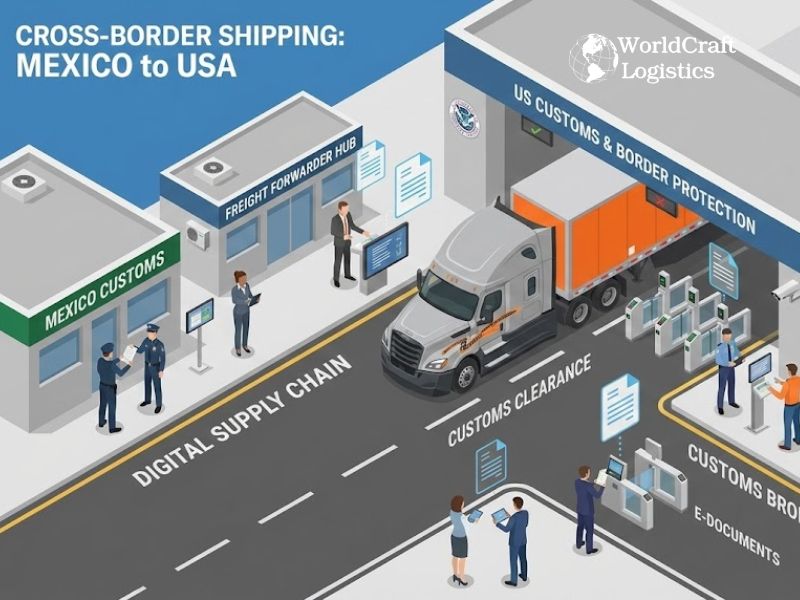
Successfully navigating the logistics of shipping from Mexico to USA requires a synchronized effort between your Mexican supplier, a licensed customs broker, and a reliable freight forwarder. The process has become increasingly digital in 2025, demanding real-time data accuracy to prevent border hold-ups. Following this structured workflow ensures that your cargo moves efficiently through the North American trade corridor.
Before shipping, the Mexican exporter must be registered in the Padrón de Exportadores and possess a valid RFC (Registro Federal de Contribuyentes). Without this tax ID, the Pedimento cannot be generated, and the shipment will be legally stuck at the point of origin.
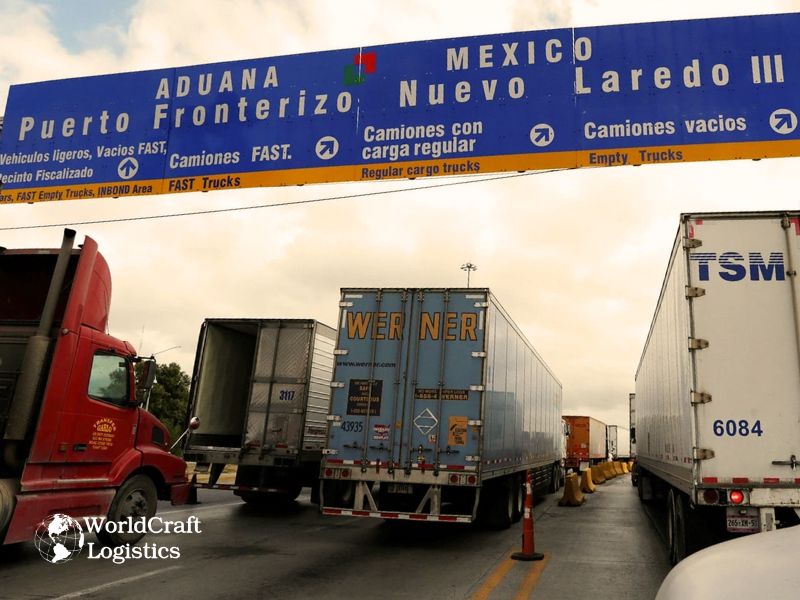
You must identify the correct 10-digit HTS code for your goods. For businesses prioritizing speed, choosing a C-TPAT (Customs-Trade Partnership Against Terrorism) certified carrier is essential. This allows your truck to use FAST lanes at the border, reducing inspection times from hours to minutes.
Your Mexican customs broker will file the Pedimento. At this stage, the Electronic Value Manifestation (MVE) must also be submitted through the VUCEM portal to verify the transaction value and prevent under-invoicing audits.
For land shipments, a specialized drayage carrier handles the short-haul move across the international bridge. This is a critical bottleneck where most delays occur; ensuring your drayage provider has pre-cleared paperwork is the key to a 24-hour crossing.
Once the CBP releases the shipment, the U.S. broker files the entry. A vital but often overlooked step is securing Cross-Border Cargo Insurance. Standard Mexican carrier liability is extremely limited, and U.S. policies often stop at the border; a through-policy is required to protect your investment from origin to destination.
In the current regulatory climate, missing or inaccurate paperwork is the primary cause of seized shipments. To ensure a seamless experience when shipping from Mexico to USA, you must maintain a digital lane packet that includes several essential documents. The Commercial Invoice remains the most critical, and in 2025, it must explicitly detail the transaction terms (Incoterms), unit prices in USD, and specific item descriptions that align perfectly with your packing list.
Beyond the invoice, the USMCA Certificate of Origin is your tool for eliminating tariffs. Unlike previous agreements, there is no official government form; however, your certification must contain nine mandatory data elements, including the certifier's status and the specific Origin Criterion. Additionally, a Bill of Lading (BOL) serves as the legal contract of carriage, and for bulk or containerized freight, a detailed Packing List is mandatory to assist CBP officers during potential physical inspections.
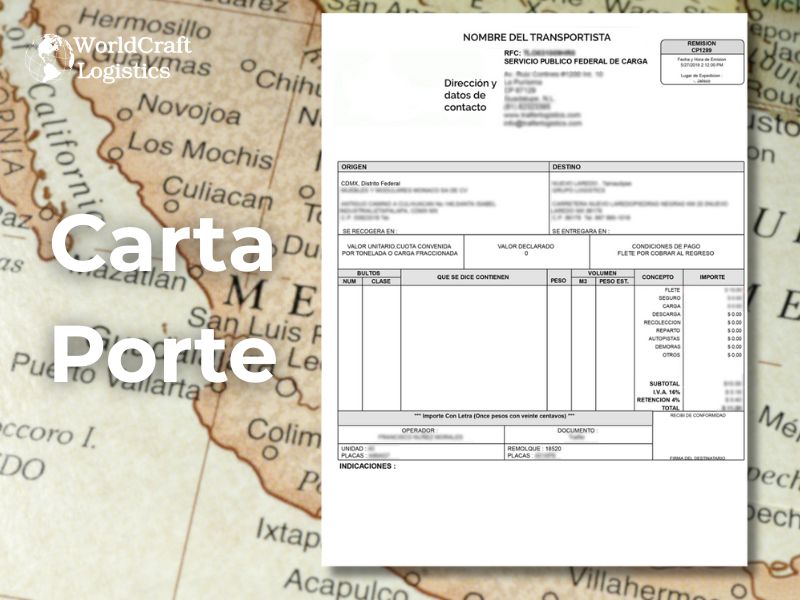
One of the most significant hurdles when shipping from Mexico to USA is the Complemento Carta Porte. This is a mandatory digital tax supplement that must be attached to the Mexican electronic invoice (CFDI) for any goods moving via road, rail, air, or sea within Mexican territory. Its purpose is to combat the transport of contraband by providing the SAT (Mexico’s Tax Administration Service) with total visibility into the cargo, the vehicle, the driver, and the specific route.
Failure to produce a valid Carta Porte during a roadside inspection in Mexico can lead to the immediate impounding of the vehicle and significant fines for both the shipper and the carrier. As a business shipping from Mexico to USA, you are responsible for providing your carrier with the correct HTS codes and location coordinates to generate this document. At Worldcraft Logistics, we coordinate directly with Mexican carriers to ensure that your Carta Porte data is synchronized with your international shipping documents, preventing costly disruptions before your freight even reaches the border.
Why is C-TPAT certification a game-changer for your timeline? C-TPAT is a voluntary supply chain security program. When you use C-TPAT certified partners for shipping from Mexico to USA, your shipments are considered low risk. This results in a significantly lower percentage of physical secondary inspections and priority processing during periods of high border congestion, which is common in 2025.
*Related topics for you:
Over the past several years, Mexico has firmly established itself as the United States’ leading trading partner, driven largely by the acceleration of nearshoring strategies and the reconfiguration of global supply chains. For supply chain leaders and e-commerce businesses, shipping from Mexico to the USA has evolved beyond a routine logistics function into a strategic pillar for maintaining operational resilience across North America.
This cross-border logistics ecosystem continues to be shaped by the USMCA framework, which provides substantial duty-free benefits while placing greater emphasis on documentation accuracy, rules of origin, and regulatory compliance. As bilateral trade volumes move steadily toward and are expected to exceed the $800 billion mark in the coming years, major border gateways such as Laredo, El Paso, and Otay Mesa remain critical arteries supporting industries like automotive, aerospace, electronics, and advanced manufacturing.
Looking ahead into 2026, the complexity of cross-border transportation is expected to intensify rather than ease. Shippers must contend with increasingly digitalized compliance requirements, including Mexico’s Carta Porte regulations, evolving customs enforcement practices, volatile fuel surcharges, and intermittent congestion at key seaports such as Manzanillo. At the same time, investments in infrastructure, technology, and cross-border collaboration are creating new opportunities for faster transit times and more cost-efficient routing.
In this context, a proactive and informed approach to cross-border shipping is essential. This guide examines the current operating environment while anticipating emerging trends, helping shippers optimize cross-border flows, reduce friction at the border, and position their supply chains for sustainable growth through 2026 and beyond.
>>> Read more: Cross Border Freight Guide: Logistics & Shipping Solutions
Selecting the appropriate transportation method for shipping from Mexico to USA is a balancing act between cost, speed, and the vulnerability of your cargo. With fuel surcharges hovering between 18% and 25%, the default choice of trucking is being challenged by intermodal rail and ocean lanes. If businesses choosing the wrong mode doesn't just increase costs it introduces unmanaged risks like cargo theft in high-risk zones or terminal demurrage that can erode your entire profit margin.
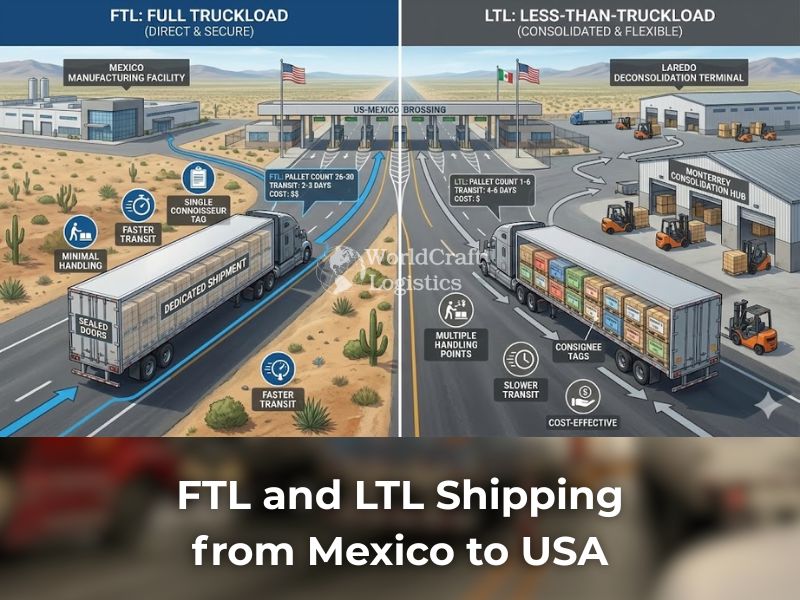
Road freight remains the dominant force for shipping from Mexico to USA, carrying over 60% of the total trade value. However, the decision between Full Truckload (FTL) and Less-than-Truckload (LTL) has become more complex due to driver shortages and fluctuating spot rates.
Full Truckload (FTL): This is the gold standard for high-security or high-volume freight. Because the trailer is dedicated to your cargo, it travels directly from the origin in Mexico to the destination in the US (often via a transload at the border), which is vital for preventing damage and theft.
Less-than-Truckload (LTL): For smaller shipments between 150 lbs and 15,000 lbs, LTL allows you to pay only for the space you use. While cost-effective, LTL involves multiple consolidations at various terminals. LTL transit times are seeing increased volatility due to labour constraints at major hubs like Monterrey and Laredo.
How do I choose between FTL and LTL when shipping from Mexico to USA? The break-even point typically occurs around 12 to 14 pallets. If your shipment exceeds this volume or contains fragile components, FTL is almost always the safer and more cost-effective choice in the long run. For SMBs with frequent, smaller orders, a consolidated LTL strategy managed by a 3PL can save 20–40% on base freight costs.
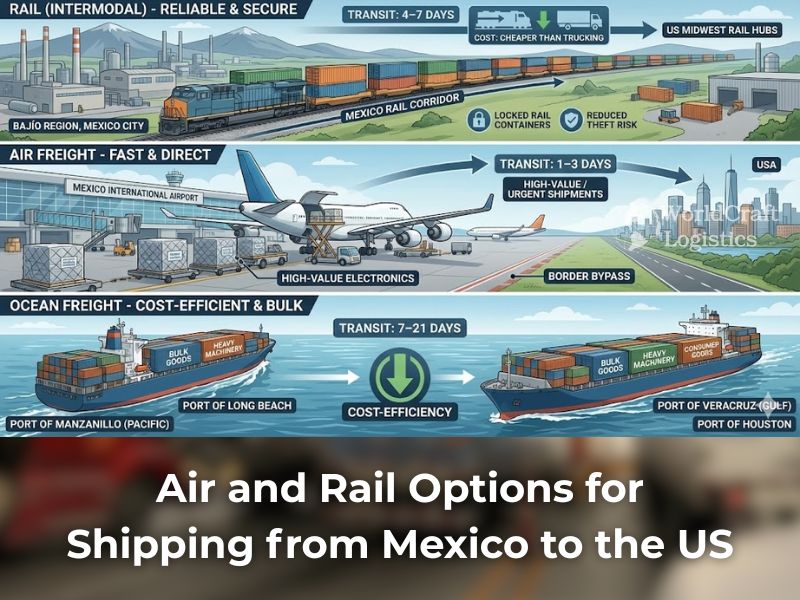
While trucking is the most common method, it is often the most susceptible to border congestion. For companies shipping from Mexico to USA from deep-interior manufacturing hubs like the Bajío region or Mexico City, alternative modes offer significant strategic advantages.
Intermodal Rail: This is the secret weapon for high-volume, long-haul shippers. Rail is typically 10–25% cheaper than trucking and offers superior security, as rail cars are less targeted by highway cargo theft than trucks. With the 2025 expansion of Falcon Premium services, rail transit times from Central Mexico to the US Midwest now rival trucking, often arriving in 4–7 days.
Air Freight: When your supply chain is facing a line-down situation or you are shipping high-value electronics, air freight is the only option. Despite being the most expensive mode, averaging $5 to $12 per kg, it offers a door-to-door transit time of just 1–3 days, bypassing the physical land border entirely.
Ocean Freight: Often overlooked, shipping containers from ports like Manzanillo (Pacific) or Veracruz (Gulf) to US ports like Long Beach or Houston is ideal for bulk goods. While transit times are longer (7–21 days), ocean freight remains the cheapest method for moving heavy machinery or raw materials that aren't time-sensitive.
Mode | Avg. Transit Time (Door-to-Door) | Estimated 2025 Cost | Best Used For |
FTL Truck | 1–5 Days | $1,800 – $3,500 per load | Urgent, high-volume, high-security cargo |
LTL Truck | 5–10 Days | $1.50 – $3.50 per kg | Small pallets, SMB inventory, flexible timelines |
Intermodal Rail | 4–8 Days | 15–20% less than FTL | Heavy bulk, long-haul (e.g., Silao to Chicago) |
Air Freight | 1–3 Days | $5.00 – $12.00 per kg | Electronics, pharma, emergency parts |
Ocean (FCL) | 7–21 Days | $1,200 – $3,000 per container | Oversized goods, lowest-cost bulk shipments |
Ready to move your shipments from Mexico to the USA faster and more efficiently? Worldcraft Logistics’ Air Freight and Trucking Transport services deliver speed, reliability, and full customs support to keep your supply chain running smoothly. Contact our experts today to get a tailored logistics solution that reduces transit time and total shipping costs.
The average price for shipping from Mexico to the US in late typically ranges from $200 per pallet for LTL shipments to $4,500 for full truckloads on long-haul routes. Because Mexico is now the primary trading partner for the U.S., demand for these lanes is at an all-time high, meaning rates are heavily influenced by the specific crossing point and the urgency of the freight. To help you budget accurately, the following data provides a transparent breakdown of the current market rates.
A professional estimate for shipping from Mexico to the USA depends on the weight, volume, and specific lane you are using. Below is a detailed reference price list based on Q4 2025 market data for standard cargo.
Route (Origin to Destination) | Transport Mode | Load Type | Estimated 2025 Base Rate (USD) |
Monterrey to Laredo/San Antonio | Truck | FTL (Dry Van) | $1,800 – $2,400 |
Mexico City to Los Angeles | Truck | FTL (Dry Van) | $2,800 – $3,600 |
Guadalajara to Chicago | Truck | FTL (Dry Van) | $3,200 – $4,200 |
Queretaro to Houston | Truck | LTL (Per Pallet) | $250 – $450 |
Tijuana to San Diego | Truck | LTL (Per KG) | $1.50 – $1.85 |
Mexico City to Miami | Air | Per KG (Express) | $5.50 – $8.50 |
Veracruz to Savannah | Ocean | 20ft Container | $1,400 – $1,900 |
What is the updated average cost of shipping from Mexico to the USA? In late 2025, the average cost for an FTL ranges between $2,500 and $4,500, depending on the distance, while LTL rates average $1.50 to $3.50 per kilogram. Air freight remains the premium option at $5.00 to $12.00 per kilogram, while ocean containers FCL fluctuate between $1,200 and $3,000 based on the port of entry.
The price of shipping from Mexico to USA is not limited to the base freight rate. Several mandatory surcharges and regulatory fees must be added to your total logistics budget to avoid surprise invoices.
Fuel Surcharges (FSC): Currently averaging 24% to 26% of the base freight cost for cross-border trucking.
Border Crossing & Drayage: A specialized bridge move fee of $250 – $500 is standard for land crossings.
Merchandise Processing Fee (MPF): Effective October 1, 2025, U.S. Customs (CBP) set the formal entry minimum at $33.58 and the maximum at $651.50.
Customs Brokerage: Professional filing fees range from $150 to $350 per entry, depending on the complexity and number of HTS lines.
Digital Document Fees: Carriers now charge a nominal fee of $25 – $50 for the generation and validation of the mandatory Carta Porte digital tax supplement.
To achieve the cheapest shipping from Mexico to USA, focus on optimizing volume and compliance rather than chasing low spot rates. The biggest cost driver is border delays caused by documentation errors, which can trigger demurrage fees exceeding $150 per day.
One of the most effective cost-saving strategies is Inland Consolidation. Consolidating multiple small shipments at warehouses in Monterrey or Mexico City into a single full truckload helps avoid the high per-pallet costs of LTL freight. Additionally, auditing your HS Codes is critical, as incorrect classifications often result in unnecessary duties instead of qualifying for 0% USMCA tariffs.
Finally, working with C-TPAT certified carriers reduces the risk of inspections by granting access to FAST lanes minimizing delays and inspection fees that can range from $100 to $600 per shipment.
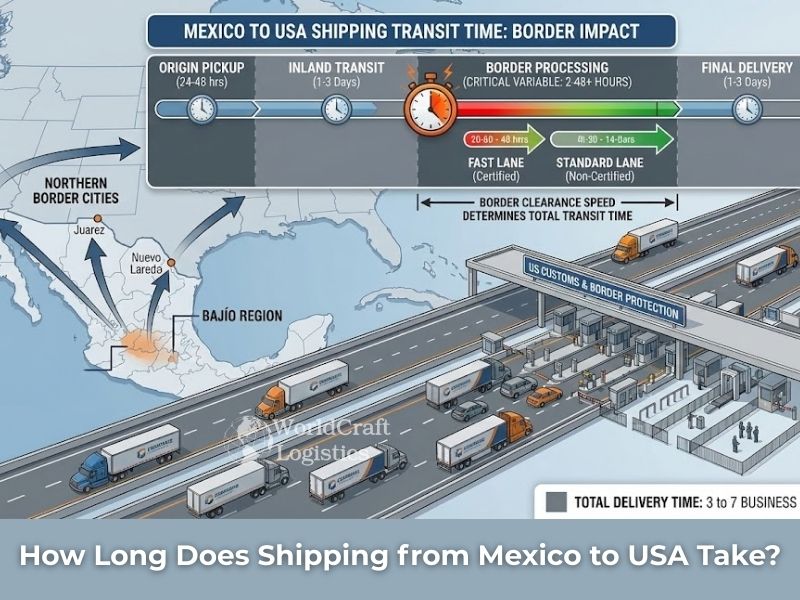
In the current 2025 logistics landscape, the average time for shipping from Mexico to USA ranges from 24 hours to 7 business days for land-based freight. While the distance is shorter than transpacific routes, the real transit time is dictated by border processing speed rather than vehicle velocity. For high-velocity supply chains, understanding these windows is essential for inventory planning. The duration of shipping from Mexico to the USA varies significantly based on your chosen transport mode and the distance from the Mexican industrial heartland to your U.S. destination.
Navigating the complexities of shipping from Mexico to USA requires more than just a carrier; it requires a strategic partner with deep cross-border expertise. At Worldcraft Logistics, we provide a one-stop solution that bridges the gap between Mexican manufacturing and U.S. distribution.
USMCA Compliance Experts: We ensure your documentation is audited for maximum duty savings and zero penalties.
C-TPAT Certified Network: Our shipments utilize the fast lanes at the border, significantly reducing wait times and inspection frequencies.
Real-Time Visibility: Our digital platform tracks your cargo from the warehouse in Monterrey to the final mile in New York.
Bilingual Support: We manage communications with Mexican suppliers and U.S. buyers, eliminating the language barriers that cause logistics friction.
Are you ready to optimize your cross-border logistics chain? Don't let complicated customs procedures or fluctuating costs disrupt your cargo flow. Optimized for both small shipments and large-volume full-truckload shipments, Worldcraft Logistics offers a USMCA-compliant operating system and a wide, reputable transportation network to ensure your goods clear customs quickly, reliably, and cost-effectively. Get a customized quote today and experience the difference of a true cross-border logistics partner.
>>> GET A QUOTE NOW

SEO
Digital Marketing/SEO Specialist
Simon Mang is the SEO and Digital Marketing Specialist at Worldcraft Logistics, where he leads content strategy to promote the company's online presence. With years of experience in digital marketing and a strong understanding of the logistics industry, he has published more than 500 specialized articles across freight, warehousing, and supply chain topics. ( Reviewed for accuracy by the Worldcraft Logistics Operations Team ).