03/10/2026
Navigating the financial pressures of global supply chains in 2026 requires more than just moving freight from point A to point B. For US importers, unexpected customs duties, aggressive CBP audits, and tight cash flow are very real, daily sources of stress. If you are bringing high-value goods into the United States, paying massive import duties upfront before you have even secured domestic buyers can paralyze your working capital.
This is where a strategic import duty suspension strategy comes into play. If you find yourself constantly battling cash flow constraints tied up in customs entry fees, understanding how to leverage a bonded warehouse is one of the most powerful financial tools at your disposal. This guide breaks down exactly how bonded storage works, the true costs involved, and how to determine if it is the right risk mitigation strategy for your supply chain.
A customs bonded warehouse is a highly secure storage facility supervised by U.S. Customs and Border Protection (CBP). It allows importers to store dutiable goods for up to five years without paying import duties or taxes until the merchandise is officially withdrawn for domestic sale or exported.
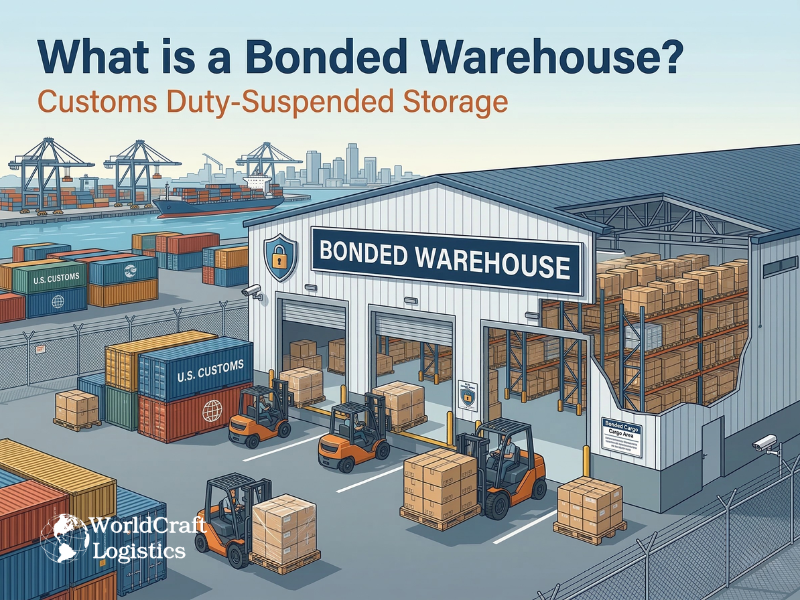
When your freight arrives at a US port of entry, CBP requires a customs entry filing. Normally, this means paying duties immediately. By routing your goods to a bonded facility, the warehouse proprietor accepts liability for the goods under a specialized warehouse bond. This bond guarantees to the US government that the duties will eventually be paid, allowing you to defer the actual cash payout.
A common misconception is that bonded inventory is somehow "tax-free." It is not. Bonded inventory simply refers to imported goods sitting in regulatory limbo. The taxes and duties are suspended, not erased. As long as the goods remain in the facility and comply with CBP regulations, you retain your cash. The moment those goods enter the US commercial market, the deferred duties become payable at the current tariff rate.
| *Check the following references from the U.S. government: https://www.help.cbp.gov/s/article/Article1853?language=en_US https://www.help.cbp.gov/s/article/Article-1140?language=en_US |
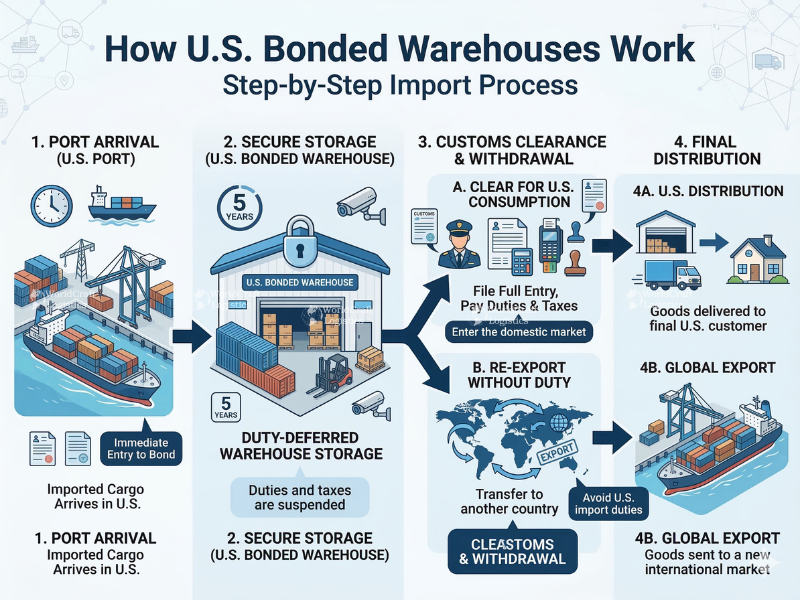
How does a bonded warehouse work? The process involves four steps: filing a warehouse customs entry at the port, moving goods via a licensed bonded carrier, storing the items securely under CBP supervision for up to five years, and finally withdrawing the goods by either paying domestic duties or re-exporting them tax-free.
Here is the operational workflow you can expect:
When your ocean or air freight arrives at a major hub like the Port of Los Angeles or Miami, your customs broker files a specific warehouse entry (typically a Type 21 or 22 entry). This signals to CBP that the goods will not immediately enter domestic commerce.
You cannot use just any trucking company to move uncleared goods. The shipment must be transported via an in-bond shipment using a licensed bonded carrier. This ensures the chain of custody remains unbroken and secure between the port and the warehouse.
Once received, the goods can be stored for up to five years. Under 19 CFR Part 19, you are allowed to perform certain "manipulations" under CBP supervision. This includes cleaning, sorting, repacking, or changing the condition of the goods, provided you do not fundamentally manufacture them into a new product.
You have three primary exit routes for your bonded inventory:
Domestic Consumption: You withdraw a portion of the goods to sell in the US, filing a withdrawal entry and paying duties only on that specific portion.
Re-export: You sell the goods to a buyer in Canada, Mexico, or overseas. The goods leave the US, and you pay absolutely zero US import duties.
Destruction: If the goods are damaged or unsellable, they can be destroyed under CBP supervision, waiving the duty requirement.
Related articles:
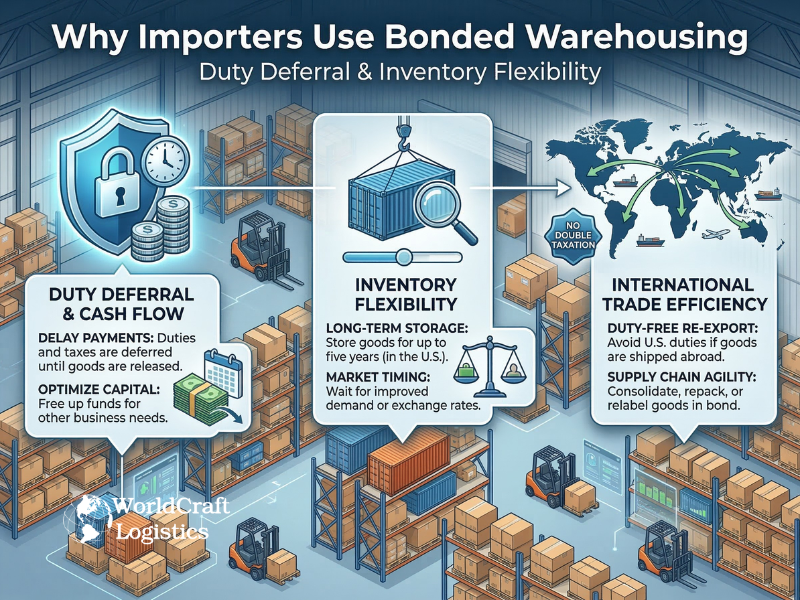
Choosing to use a bonded facility is rarely about standard storage; it is a calculated financial decision.
Imagine importing $1 million in inventory with a 15% tariff rate. Paying $150,000 upfront ties up capital that could be used for marketing, payroll, or purchasing more inventory. By utilizing bonded distribution, you can withdraw and pay that $150,000 in smaller increments over months or years as the product actually sells.
If you serve a global market from a US hub, bonded storage is a necessity. Importing goods to the US only to ship them to South America usually requires a complex, delayed duty drawback process to get your taxes refunded. By keeping goods bonded, you bypass the duty drawback nightmare entirely. You simply re-export the goods and never pay the US tax in the first place.
If you import goods subject to strict CBP quotas, you can store excess inventory in bonds until the next quota period opens. It is also highly effective for holiday inventory, allowing you to bring goods in early when ocean freight rates are lower, deferring the duty until peak season.
Not all bonded facilities are the same. US Customs categorizes them into 11 distinct classes. While most 3PL providers operate Class 3 or 8 facilities, knowing the landscape is crucial for compliance.
Class 1: Government-owned premises used for seized or exam goods.
Class 2 & 3: Private (Class 2) and Public (Class 3) bonded warehouses used exclusively for storage. Class 3 is the standard tier for 3PLs managing multi-client inventory.
Class 4 & 5: Bonded yards for heavy/bulky items (like livestock or machinery) and grain elevators.
Class 6 & 7: Facilities strictly for manufacturing in bond (for export only) and smelting/refining of imported metals.
Class 8: Facilities strictly for cleaning, sorting, and repacking (manipulation) without manufacturing.
Class 9 & 10: Duty-free stores and international travel merchandise holding areas.
Class 11: General Order (G.O.) merchandise facilities for goods left unclaimed at a port for more than 15 days.
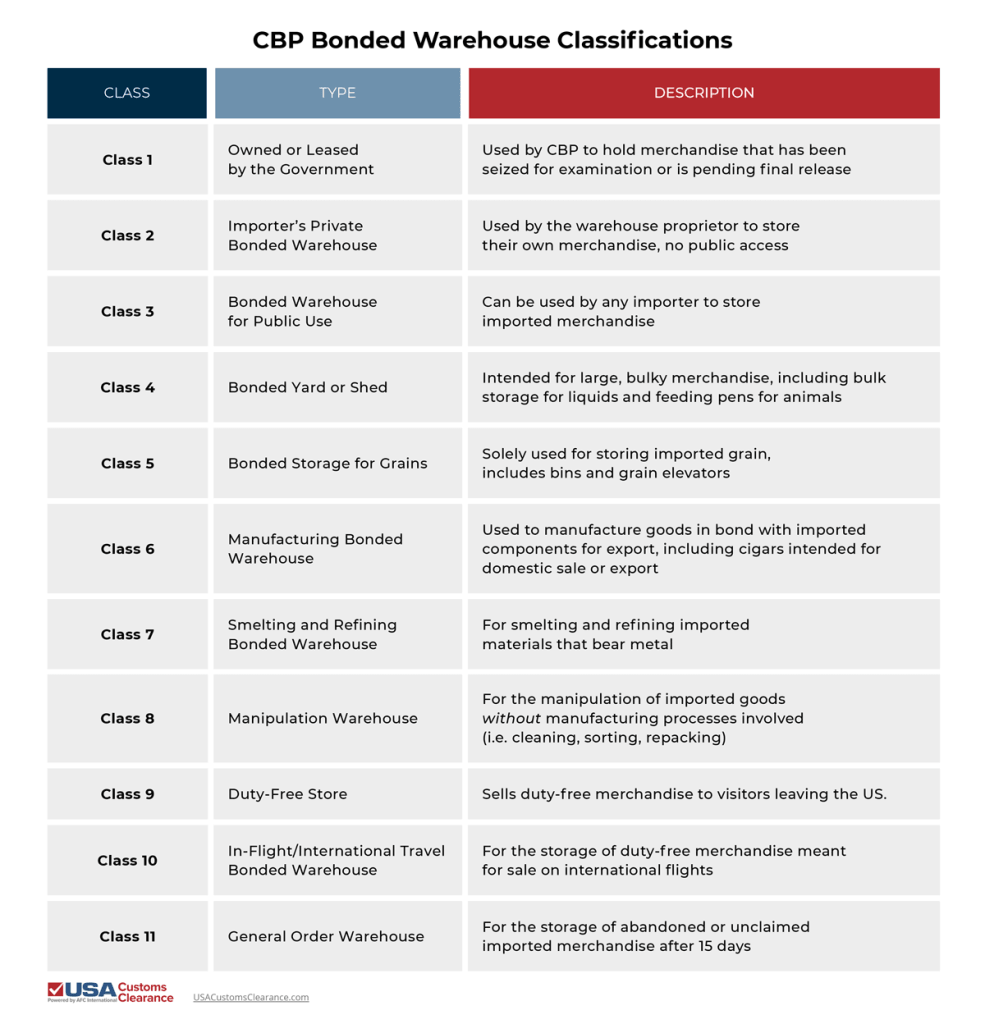
CBP Bonded Warehouse Classifications (Source by USA Customs Clearance)
Understanding the difference between these three options is critical for supply chain risk management.
Duties are paid immediately at the port of entry before the goods arrive at the warehouse. This is ideal for fast-moving consumer goods that will be sold domestically within days or weeks of arrival.
Importers frequently confuse bonded warehouses with Foreign Trade Zones (FTZs). While both defer duties, they operate under different legal frameworks.
Duration: Bonded warehouses have a strict 5-year limit. FTZs allow indefinite storage.
Manufacturing: You cannot manufacture goods for domestic sale in a standard bonded warehouse. FTZs allow extensive manufacturing and assembly.
Customs Entry: Bonded goods require a customs entry before moving to the warehouse. FTZ goods only require entry upon leaving the zone, allowing importers to consolidate weekly entries and save significantly on Merchandise Processing Fees (MPF).
Bonded storage is highly cost-effective for goods with high tariff rates, long shelf lives, or those intended for re-export. However, it is not worth it for fast-moving consumer goods with low margins or zero duties, as the administrative costs of customs entries and bond fees outpace the deferment benefits.
It is vital to be transparent: bonded warehousing is not inherently cheaper than standard warehousing. You will pay standard pallet and space storage fees, plus added administrative overhead. Facility operators must carry an expensive customs warehouse bond and maintain rigorous, CBP-approved inventory management systems (like strict FIFO tracking). These compliance costs are baked into your 3PL rates. The ROI comes entirely from the capital you save by deferring taxes.
The primary risk is non-compliance. If you lose track of time and leave goods in the facility past the 5-year mark, CBP can seize the freight or issue severe financial penalties. Additionally, missing paperwork on withdrawal entries can trigger comprehensive CBP audits. Partnering with a logistics provider that understands exact US regulations is non-negotiable.
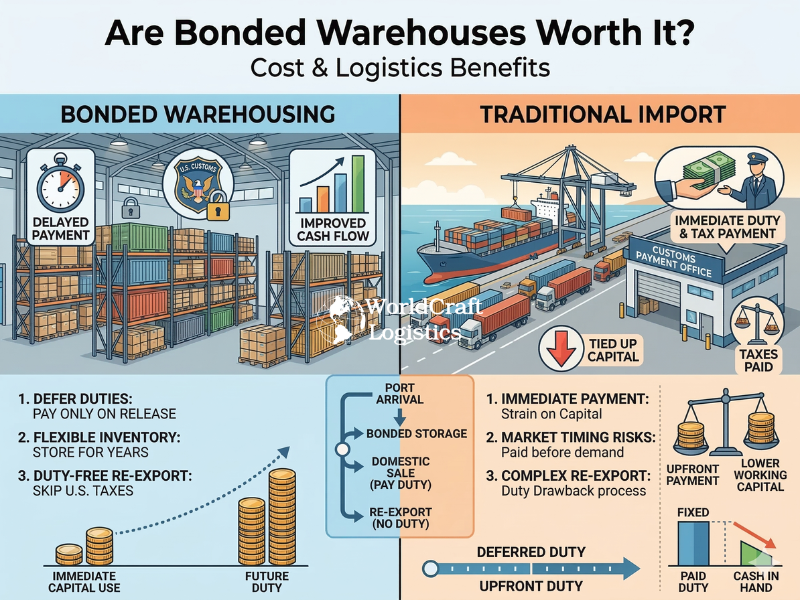
Let’s look at a realistic 2026 scenario. A US-based electronics distributor imports $2 million worth of components through the Port of Los Angeles, facing a steep 25% Section 301 tariff ($500,000).
If they use a non-bonded 3PL, they must write a $500,000 check to CBP before the goods even leave the port.
Instead, they route the shipment to a Class 3 bonded warehouse. They withdraw 10% of the inventory each month as e-commerce sales roll in. They pay $50,000 in duties monthly over 10 months. This strategy preserves $450,000 in immediate working capital during month one, allowing them to fund their digital marketing campaigns to actually sell the product.
Selecting a facility goes beyond finding the lowest storage rate per pallet. You are entrusting a partner with your CBP compliance. When vetting a 3PL, look for:
Flawless inventory management systems that easily generate reports for CBP audits.
Deep experience coordinating in-bond transfers from your specific ports of entry.
High-level physical security (CBP requires strict access control for bonded areas).
Transparent pricing that separates physical storage costs from customs administration fees.
If you are evaluating your import strategy for the upcoming year and want to protect your cash flow from unpredictable tariff impacts, it is time to look at integrated 3PL warehousing solutions.
Would you like me to help you review your specific duty deferment strategy?
👉 Speak with a Worldcraft Logistics bonded warehouse specialist today to request a 2026 bonded storage consultation.
While both operate under U.S. Customs supervision, they serve completely different purposes. A bonded warehouse (typically Classes 2 through 8) is a commercial logistics facility used by importers and B2B distributors to store bulk goods and defer import duties. A bonded store, classified as a Class 9 facility by CBP, is a retail environment. The most common example is a duty-free shop in an international airport terminal. Bonded stores sell individual items directly to consumers who are departing the country, allowing them to purchase goods without paying local taxes, provided the items are exported immediately.
Under current U.S. Customs and Border Protection (CBP) regulations (19 CFR Part 19), imported merchandise can remain in a customs bonded warehouse for up to five (5) years from the date of importation. This five-year period provides ample time for importers to find buyers, wait out unfavorable market conditions, or manage quota restrictions. It is crucial to track this timeline closely; if goods are not officially withdrawn for domestic consumption, re-exported, or destroyed before the five-year deadline expires, they are subject to seizure and auction by the US government.
Generally, no. Standard public bonded warehouses (Class 3) and manipulation facilities (Class 8) strictly prohibit manufacturing. In a Class 8 facility, you are allowed to perform minor manipulations under CBP supervision, such as cleaning, sorting, repacking, or relabeling goods to prepare them for sale. True manufacturing that fundamentally changes the nature of the imported product is only permitted in a highly specialized Class 6 manufacturing bonded warehouse. Furthermore, goods manufactured in a Class 6 facility must be entirely re-exported; they generally cannot be entered into US domestic commerce.
A bonded carrier is a specialized transportation company that has been vetted and licensed by U.S. Customs and Border Protection. They hold a specific customs bond that allows them to transport imported merchandise that has not yet cleared customs or had duties paid. This process is known as an "in-bond shipment." Bonded carriers are legally required to move goods securely between a port of entry and a bonded warehouse, or between two different bonded facilities, ensuring the chain of custody remains intact and no goods are illegally diverted into the domestic market.
Bonded inventory refers to imported, dutiable merchandise that is currently being stored in a highly secure, CBP-approved facility where the payment of customs duties, taxes, and fees has been temporarily suspended. The inventory is considered to be outside the commercial customs territory of the United States, even though it is physically located within the country. The goods remain classified as bonded inventory until the importer files a withdrawal entry to pay the required duties and enter the goods into domestic commerce, or until the goods are exported out of the US.
9.6. What is the purpose of a customs warehouse?
The primary purpose of a customs bonded warehouse is to facilitate and stimulate international trade by providing financial relief and flexibility to importers. By allowing companies to defer the payment of import duties and taxes, these facilities protect working capital and improve cash flow. They also serve as a strategic staging ground for companies that import goods into the US solely to re-export them to other countries, allowing those businesses to avoid the complex, time-consuming duty drawback process entirely.
Bonded warehouses are incredibly valuable, but their worth depends on your specific supply chain model. They are highly worthwhile if you import goods subjected to high tariff rates (like Section 301 duties), deal with seasonal merchandise that requires long-term storage, or frequently re-export goods internationally. Conversely, they are not worth the investment if you import fast-moving consumer goods with very low or zero duty rates that are sold and shipped to domestic customers within days of arriving at the port, as the administrative costs will outweigh the deferment benefits.
The cost of utilizing a bonded warehouse is multifaceted. You will pay standard 3PL rates for physical storage space (by pallet or square footage) and handling labor. However, you must also factor in administrative fees for the heightened level of inventory tracking and the cost of filing individual customs withdrawal entries every time goods are pulled for domestic sale. Additionally, the warehouse proprietor passes on a fraction of the cost of maintaining their expensive continuous customs bond. While base storage rates are comparable to regular warehouses, compliance overhead makes it slightly more expensive.
Operating a bonded warehouse in the US requires rigorous adherence to CBP regulations. A warehouse proprietor must submit a detailed application to their local CBP port director, demonstrating the physical security of the facility. They must secure a substantial continuous customs bond to cover potential duty liabilities. Operations require meticulous, CBP-approved digital inventory management systems (usually tracking goods strictly by FIFO). The facility is also subject to unannounced CBP audits, background checks on key personnel, and strict physical access controls to the bonded areas.
If imported merchandise remains in a U.S. bonded warehouse beyond the strict five-year statutory limit, the importer faces severe consequences. CBP considers the goods to be abandoned. The merchandise will be transferred to a General Order (G.O.) status or seized directly by the government. Once seized, CBP has the authority to sell the goods at a public auction to recoup the unpaid duties, taxes, and storage fees. Importers may also face financial penalties and liquidated damages filed against their own customs bonds for failing to comply with 19 CFR regulations.

SEO
Digital Marketing/SEO Specialist
Simon Mang is the SEO and Digital Marketing Specialist at Worldcraft Logistics, where he leads content strategy to promote the company's online presence. With years of experience in digital marketing and a strong understanding of the logistics industry, he has published more than 500 specialized articles across freight, warehousing, and supply chain topics. ( Reviewed for accuracy by the Worldcraft Logistics Operations Team ).